Digital Deception and Marriage Annulment: Understanding Online Profile Fraud in Matrimonial Cases

This Article is written by Adv. Aman Chawla, Family Law Expert | Delhi High Court & Supreme Court of India
Practising in Family & Matrimonial Law | Jangpura, New Delhi
Introduction: When Love is Built on Lies
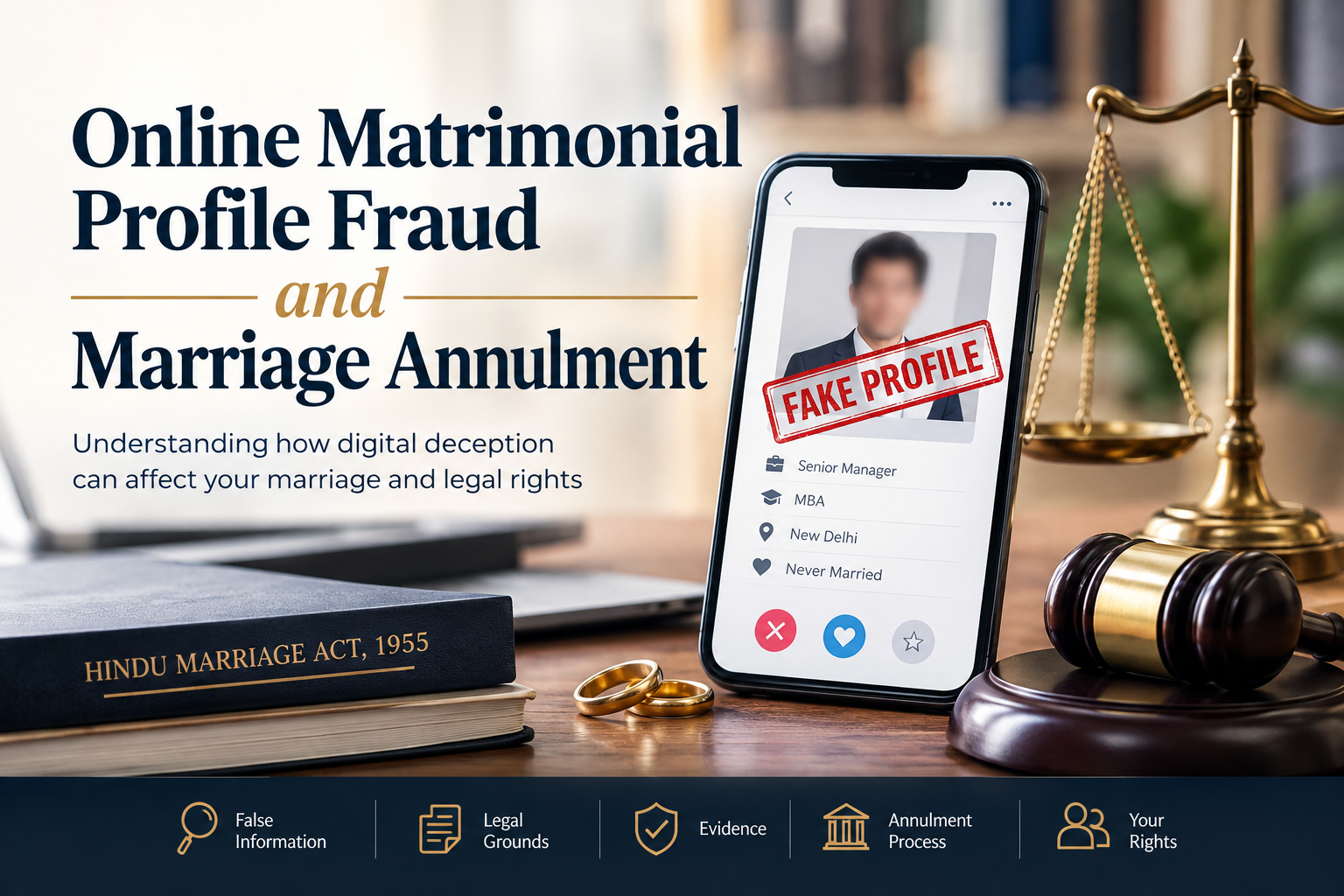
In India, online matrimonial profile fraud is becoming an important issue in matrimonial disputes. A person may discover after marriage that their spouse provided false information about income, education, employment, age, previous marriage, health, or identity through an online matrimonial profile. When such deception affects the decision to marry, it can raise important questions about consent, evidence, and possible marriage annulment under matrimonial law.
Part 1: The Rise of Online Matrimonial Fraud
Understanding the Scale of the Problem
The matrimonial industry in India has witnessed explosive growth, with online platforms facilitating approximately 7% of all marriages in urban areas. However, this digital revolution has created unprecedented opportunities for fraud. Unlike traditional matrimonial arrangements where verification was done through family networks, online profiles are self-reported and often go unverified.
Common forms of online matrimonial fraud include:
- Financial Misrepresentation: Inflating income, hiding debt, or falsifying employment status
- Educational Fraud: Claiming degrees that don’t exist or exaggerating qualifications
- Identity Deception: Using photoshopped images or someone else’s photographs
- Marital History Concealment: Hiding previous divorces or marriages
- Age Manipulation: Lying about age to attract compatible matches
- Caste and Religion Misrepresentation: False claims about religious affiliation or caste status
- Health Condition Concealment: Hiding serious illnesses or genetic conditions
According to recent surveys by matrimonial websites, approximately 35-40% of profiles contain some form of misrepresentation, though the severity varies. While minor exaggerations might be overlooked, systematic and material fraud has increasingly become the subject of matrimonial litigation.
Why Profile Fraud Matters in Marriage Law
Indian matrimonial law is fundamentally grounded in the principle of informed consent. Both parties must freely and voluntarily consent to marriage with full knowledge of the material facts. When one party deliberately withholds or misrepresents information that would reasonably affect the decision to marry, the very foundation of consent is undermined.
This is where online profile fraud intersects with marriage annulment law.
Part 2: Legal Grounds for Marriage Annulment in India
The Hindu Marriage Act, 1955: Statutory Framework
Before understanding how profile fraud affects marriage validity, it’s important to understand the different grounds available under Indian law. Unlike divorce, which dissolves a valid marriage, marriage annulment declares the marriage to have been void or voidable from its inception.
Section 12 of the Hindu Marriage Act provides grounds for VOIDABLE marriages:
The key grounds relevant to profile fraud are:
1. Section 12(1)(a) – Impotency: If one party was impotent at the time of marriage and at the time of filing the petition.
2. Section 12(1)(b) – Duress or Fraud: If the marriage was contracted under duress or with fraud. This is the primary section invoked in profile fraud cases.
3. Section 12(1)(c) – Mental Disorder: If the respondent was suffering from unsoundness of mind at the time of marriage.
4. Section 12(1)(d) – Venereal Disease: If the respondent was suffering from a venereal disease at the time of marriage.
Void Marriages (Section 11): In contrast, void marriages are automatically invalid from inception and require no court order. These include marriages contracted when either party was underage or marriages where one party was already married.
The Fraud Clause: Section 12(1)(b) in Profile Fraud Cases
Section 12(1)(b) of the Hindu Marriage Act states that a marriage is voidable if it was “contracted with the fraud of either party.” However, Indian courts have developed specific jurisprudence regarding what constitutes “fraud” sufficient to annul a marriage.
Courts have distinguished between:
- Fraud in the factum: Goes to the very essence of the marriage contract (example: marrying a person under false identity)
- Fraud in the inducement: Relates to circumstances that induced one party to marry (example: false claims about income or qualifications)
Traditionally, Indian courts required that fraud be of such a nature that it goes to the “root of the marriage”—not mere exaggeration or misrepresentation of non-essential qualities.
Part 3: Landmark Delhi High Court Judgment on Profile Fraud
The Turning Point: Profile Fraud and Marriage Annulment
In a significant 2025 judgment, the Delhi High Court (in the case of A v. B) recognized that systematic online profile fraud could constitute grounds for marriage annulment. The judgment established important precedents:
Key Holdings:
- Materiality of Information: Information is “material” if it would reasonably influence a reasonable person’s decision to marry. This includes financial status, previous marital history, educational qualifications, and health conditions.
- Intentionality: There must be evidence that the deception was deliberate. The person who created the fraudulent profile must have known it was false.
- Reliance: The petitioner must prove they relied on the fraudulent information when consenting to marriage.
- Proportionality Test: The court must assess whether the deception, viewed objectively, was sufficiently grave to undermine the very foundation of the marital contract.
Practical Implications:
The Delhi High Court’s approach recognizes that in the digital age, matrimonial profiles serve as the primary basis for informed consent. When these profiles contain material falsehoods, the consent itself becomes questionable.
This judgment has been cited in subsequent cases across Delhi High Court and family courts, establishing a more flexible standard for evaluating profile fraud in matrimonial cases.
What the Courts Won’t Grant Annulment For
It’s equally important to understand what doesn’t constitute sufficient grounds. Courts have rejected annulment pleas based on:
- Minor exaggerations about appearance or age (small age differences)
- Personality differences or incompatibility
- Undisclosed past romantic relationships
- Minor financial misrepresentations
- Different lifestyle expectations
- Performance anxiety or failure to consummate
The distinction is crucial: Courts look at whether the fraud goes to the heart of the marriage or merely to peripheral matters.
Part 4: Practical Steps When You Discover Profile Fraud
Initial Documentation and Evidence Gathering
If you’ve discovered that your spouse misrepresented material information in their matrimonial profile, your first step should be systematic documentation:
Essential Evidence:
- The Original Matrimonial Profile: Download or screenshot the original profile showing the false claims
- Documentary Evidence:
- Employment letters showing different income than claimed
- Educational certificates (or absence thereof)
- Previous divorce decrees
- Medical reports about health conditions
- Bank statements or financial documents
- Communication Records:
- WhatsApp messages or emails where they acknowledge the false information
- Messages discussing the deception
- Conversations with matrimonial counselors or advisors
- Witness Statements:
- Family members who can testify about reliance on false information
- Friends who can corroborate your version
- Matrimonial intermediaries if applicable
Why Professional Investigation Matters
Many individuals attempt to gather evidence themselves, but professional investigation provides crucial advantage:
- Verifiable Documentation: Evidence gathered through proper channels carries more weight in court
- Background Verification: Professional investigators can verify employment, educational qualifications, and financial status
- Chain of Custody: Professional investigation ensures evidence is admissible
- Cross-Verification: Multiple sources confirming the same falsehood strengthen your case
This is where experienced matrimonial lawyers in Delhi become invaluable. They have established relationships with investigators and can guide evidence collection to ensure it’s admissible in court.
Timeline of Action
The law places a time limit on filing annulment petitions:
For Fraud (Section 12(3) of HMA): The petition must be filed within 3 years of the marriage. After 3 years, you lose the right to seek annulment on grounds of fraud and must pursue divorce instead.
This makes timely action critical. If you discover profile fraud after marriage, you should consult a matrimonial lawyer immediately.
Part 5: The Legal Process for Marriage Annulment
Filing the Petition in Family Court
The process typically unfolds as follows:
Stage 1: Drafting and Filing
- Petition drafted with detailed allegations of fraud
- Supporting affidavits with documentary evidence
- Filing in the appropriate Family Court (based on jurisdiction)
Stage 2: Service and Response
- Respondent is served with the petition
- Respondent files reply/counter-affidavit
- Respondent may file counter-claims for maintenance or child custody
Stage 3: Evidence and Examination
- Petitioner’s witnesses examined
- Respondent’s witnesses cross-examined
- Documentary evidence presented
- Technical evidence (if any) regarding profile authenticity
Stage 4: Oral Arguments
- Both parties’ counsel present legal arguments
- Court examines consistency between evidence and allegations
- Questions regarding materiality and reliance are clarified
Stage 5: Judgment
- Court decides whether grounds for annulment are established
- If annulment is granted, marriage is declared void ab initio
- Ancillary matters (maintenance, custody) are decided
Duration and Costs
The timeline varies but typically takes:
- Contested cases: 2-4 years
- Uncontested cases: 6-12 months
Legal costs range from ₹50,000 to ₹3,00,000+ depending on case complexity and expert witnesses required.
Part 6: Crucial Legal Defenses Against Annulment Pleas
Common Arguments Made by Respondents
Understanding the defense perspective helps you prepare a stronger case:
1. “The Information Wasn’t Material” Respondents argue that the misrepresentation didn’t go to the heart of marriage. For instance, they might claim that exaggerating income by 20% is merely puffing, not fraud.
2. “The Petitioner Should Have Known” If false claims were easily verifiable (like educational qualifications), the respondent argues the petitioner was negligent in not checking and therefore cannot claim reliance.
3. “The Petitioner Acquiesced” If the petitioner continued the marriage after discovering the truth, the respondent argues they accepted the fraud and lost the right to annulment.
4. “Caveat Emptor” (Buyer Beware) Respondents sometimes argue that online matrimonial matching is inherently risky and parties must verify information themselves.
How Courts Evaluate These Defenses
Modern Delhi courts have been increasingly skeptical of these defenses:
- Materiality is objective: What would a reasonable person consider material is objectively assessed, not based on the respondent’s characterization
- Professional Misrepresentation is Serious: Courts take a dim view of false claims about profession, income, and educational qualifications
- Burden of Verification: While petitioners should exercise due diligence, they’re not expected to conduct full background checks
- Acquiescence: Continuing marriage while gathering evidence or hoping for reconciliation doesn’t negate the right to annulment
Part 7: Financial and Custodial Implications of Annulment
Maintenance and Alimony After Annulment
A common misconception is that annulment automatically denies maintenance rights. This is incorrect.
Section 25 of the Hindu Marriage Act allows courts to award maintenance (alimony) even in annulment cases if:
- One spouse is unable to earn sufficient income
- The other spouse has sufficient means
- The spouse seeking maintenance is not guilty of grave matrimonial misconduct
Importantly: The person who committed the fraud (respondent) is at a significant disadvantage in claiming maintenance. Courts rarely award alimony to the fraudulent party.
Child Custody Considerations
Annulment doesn’t affect children’s legitimacy or custody rights:
Section 16 of the Hindu Marriage Act explicitly states that a child born of a void or voidable marriage is legitimate.
Custody decisions remain independent of the annulment verdict and are determined based on the child’s best interests under Section 13 of the Hindu Marriage Act.
Property Division in Annulment
Unlike divorce (which involves partition of matrimonial property), annulment doesn’t provide statutory rights to share property acquired during marriage. However:
- If property was gifted jointly, the court may award it
- Contributions to property during marriage may be recognized
- Maintenance provides financial support
- Restitution of property (returning gifts) may be ordered
This makes understanding the difference between divorce and annulment financially significant.
Part 8: Comparative Analysis – Profile Fraud in Different Marital Laws
Special Marriage Act, 1954
For inter-religious or civil marriages, Section 23 provides similar grounds for voidable marriages based on fraud. Courts have applied the same jurisprudence regarding profile fraud.
Muslim Personal Law
In Muslim marriages, while not strictly applicable, principles of consent and misrepresentation are relevant for determining marriage validity under Islamic jurisprudence as applicable in India.
Judicial Approach Across High Courts
While Delhi High Court has been progressive, other high courts have taken varying approaches:
- Bombay High Court: Requires strict proof of materiality; has been more conservative
- Madras High Court: Has recognized proportionality testing similar to Delhi
- Calcutta High Court: Recently recognized digital fraud as viable ground
Best Practice: If matrimonial lawyers represent clients across jurisdictions, they must understand these variations.
Part 9: Preventive Measures and Red Flags
Warning Signs of Potential Profile Fraud
As an educated person seeking matrimonial alliances, knowing red flags is protective:
Be Cautious When:
- Photo Inconsistencies: Profile photos look professionally edited, heavily filtered, or don’t match person-in-person appearance
- Verification Hesitation: The person refuses background verification or sharing verifiable contact details
- Inconsistent Information: Stories about career, education, or family change over conversations
- Financial Secrecy: Refusal to discuss financial status or providing vague information
- Past Concealment: Unwillingness to discuss previous relationships or marital history
- Professional Verification Gaps: Claims about job titles that don’t match on LinkedIn or company records
- Educational Inconsistencies: Degree claims that don’t match institution records
- Age Discrepancies: Photos appear significantly different from stated age
Verification Checklist Before Marriage
Professional matrimonial lawyers often recommend verification:
- Verify educational qualifications directly with institutions
- Check employment through official company channels
- Conduct background check through professional agencies
- Verify identity through official documents
- Check marital status through marriage certificates
- Consult astral/astrological databases if important
- Verify income through IT returns or financial documents
- Verify family background through local inquiries
- Check references independently
Frequently Asked Questions (FAQs)
Q1: How long do I have to file for annulment after discovering profile fraud?
A: You have 3 years from the date of marriage to file an annulment petition on grounds of fraud under Section 12(3) of the Hindu Marriage Act. This is a strict deadline. After 3 years, you must pursue divorce instead.
Q2: Can small misrepresentations about appearance in matrimonial profiles justify annulment?
A: Generally, no. Courts distinguish between material and trivial misrepresentations. Minor exaggerations about appearance or personality don’t justify annulment. However, systematic deception about age (more than 5-7 years), physical health conditions, or appearance-altering surgeries might.
Q3: What if my spouse admits to profile fraud? Is annulment guaranteed?
A: Admission helps significantly but doesn’t automatically guarantee annulment. The court must still satisfy itself that the fraud was material and went to the root of the marriage contract. Even with admission, the court will assess whether the deception was grave enough to warrant annulment.
Q4: If annulment is granted, do I lose maintenance rights?
A: No. Even after annulment, courts can award maintenance under Section 25 if one party is unable to sustain themselves. However, the party guilty of fraud has a significantly weaker claim for maintenance. Courts consider fraud as relevant to the maintenance award.
Q5: What happens to children if marriage is annulled?
A: Children remain legitimate even after annulment under Section 16 of the Hindu Marriage Act. Custody is decided based on children’s best interests, independent of annulment. Both parents retain parental rights and obligations.
Q6: Is profile fraud easier to prove than traditional fraud claims?
A: Profile fraud actually requires systematic documentation. You must prove that the profile contained false information, that it was intentionally false, that you relied on it, and that it was material. Digital evidence (screenshots, profiles, communications) helps significantly compared to traditional fraud claims.
Q7: What is the difference between annulment and divorce on grounds of cruelty due to profile fraud?
A: Annulment voids the marriage retroactively. Divorce dissolves an otherwise valid marriage. If you discover profile fraud, annulment is preferable as it declares the marriage null from inception. However, if the 3-year deadline passes, divorce is your only option. Some people file both pleas for safety.
Q8: Can I sue the matrimonial website for profile fraud?
A: This is a developing area. You can potentially pursue civil action against matrimonial websites under the Consumer Protection Act for facilitating unverified false profiles. However, most matrimonial websites include disclaimers limiting their liability. The law in this area is still evolving.
Q9: What evidence do courts find most compelling in profile fraud cases?
A: Courts find most compelling:
- Original fraudulent matrimonial profile (screenshots)
- Documentary proof of the true facts (certificates, employment letters, divorce decrees)
- Your testimony about reliance
- Communications where your spouse admits falsehood
- Professional investigation reports
- Credible witness testimony
Q10: Should I attempt reconciliation after discovering profile fraud?
A: This is a personal choice, but legally, you should know that continuing marriage after discovering fraud can be used by the respondent to argue “acquiescence.” Some courts may interpret continued cohabitation as acceptance. If you’re contemplating annulment, consult a matrimonial lawyer before deciding on reconciliation.
Part 10: Choosing the Right Matrimonial Lawyer for Profile Fraud Cases
What to Look for in Your Lawyer
Profile fraud cases require lawyers with specific expertise:
- Matrimonial Law Specialization: General lawyers may not understand the nuances of fraud in matrimonial context
- Digital Evidence Handling: Lawyers must understand how to authenticate and present digital evidence in court
- Investigation Network: Access to professional investigators for evidence gathering
- Court Experience: Track record in family courts, particularly in profile fraud cases
- Understanding of Jurisprudence: Knowledge of recent High Court judgments on profile fraud
- Negotiation Skills: Many cases settle; your lawyer should help explore settlement options
Conclusion: Protecting Yourself in the Digital Matrimonial Age
The intersection of technology and matrimonial law is creating new challenges for couples and new opportunities for fraudsters. Digital deception in matrimonial alliances is no longer a rare edge case—it’s a growing reality in Indian matrimonial courts.
However, Indian law, particularly through progressive judgments from Delhi High Court and other benches, is evolving to address profile fraud. The recognition that online profiles are the modern basis for matrimonial consent means that material falsehoods in these profiles can indeed constitute grounds for marriage annulment.
If you discover profile fraud after marriage:
- Act quickly — Remember the 3-year deadline for annulment
- Document systematically — Preserve evidence of the fraudulent profile and the true facts
- Consult experienced matrimonial lawyers — Don’t navigate this alone; specialized legal guidance is crucial
- Understand your options — Annulment, divorce, and even settlement possibilities should be explored
More broadly, before entering matrimonial alliances, verify critical information. In an era where marriages are often preceded by online interactions, a little due diligence can prevent tremendous heartache.
The law recognizes that marriage is a solemn contract built on informed consent and mutual trust. When that foundation is deliberately undermined through profile fraud, courts are increasingly willing to recognize the right to annulment—giving you legal recourse to start fresh.
Adv. Aman Chawla practices matrimonial and family law before the Delhi High Court, Delhi Family Courts (Saket, Rohini, Dwarka, Karkardooma, Patiala House), and the Supreme Court of India. For a consultation on your specific situation, reach out through the contact details on this website.
Disclaimer: This article is for general informational purposes only and does not constitute legal advice. As per the Rules of the Bar Council of India, advocates are not permitted to advertise or solicit work, and nothing in this article should be construed as advertising, solicitation, or an invitation to engage this firm. Readers should consult a qualified advocate regarding their specific circumstances before taking any legal action.
About the Author
This article is written by legal experts at The Matrimonial Lawyers, a leading law firm in Delhi specializing in matrimonial disputes, family law, divorce proceedings, and child custody matters. Our team has extensive experience handling complex profile fraud cases and helping clients navigate the emotional and legal challenges of matrimonial disputes.
For consultation on your matrimonial matter, contact The Matrimonial Lawyers in Delhi today.