Written by Adv. Aman Chawla Matrimonial Law Specialist | Delhi High Court & Supreme Court of India 8 Years Exclusive Practice in Matrimonial & Family Law.
Introduction
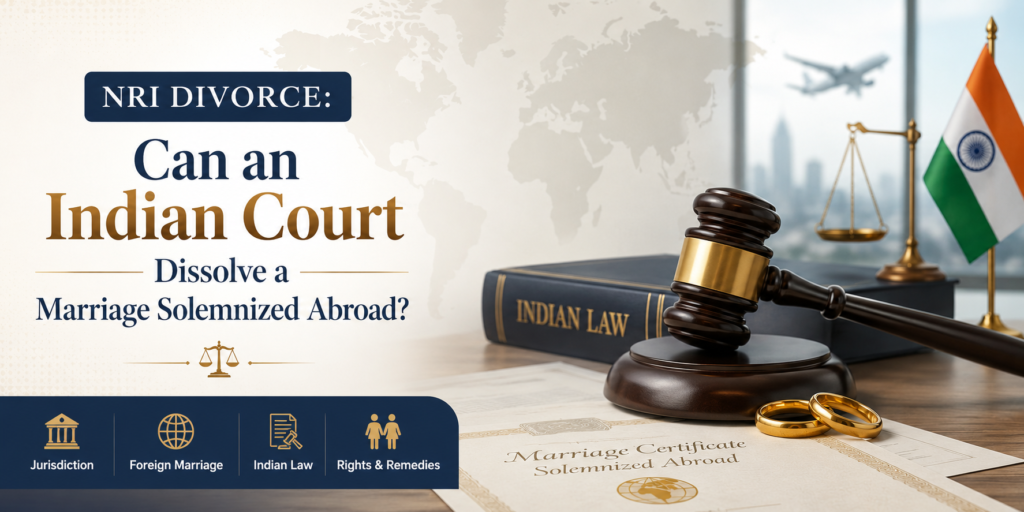
Every year, thousands of Indian nationals who are married abroad — in the United States, United Kingdom, Canada, Australia, or the Gulf — find themselves at a crossroads: the marriage has broken down, but they are unsure whether Indian courts have any authority to grant them a divorce. Some believe that because the marriage was performed on foreign soil, India has no say. Others rush to file a petition in India only to have it dismissed for lack of jurisdiction. NRI Divorce Lawyer in Delhi.
This article addresses, with precision, the legal framework that governs when and how an Indian court can dissolve a marriage solemnized abroad. It covers jurisdiction under the Hindu Marriage Act and Special Marriage Act, the enforceability of foreign divorce decrees, and practical guidance for NRIs seeking legal separation in India.
The question is not merely academic. A wrong choice of forum can delay your divorce by years, invalidate your decree, and expose you to criminal liability under Section 494 IPC / BNS for bigamy if you remarry.
1. The Core Legal Question: What Governs Jurisdiction?
Indian matrimonial law does not simply follow the place of marriage. Instead, jurisdiction of Indian courts is governed by the personal law applicable to the parties and the connecting factors that tie the parties — not the ceremony — to India.
The two primary statutes that deal with this question are:
- The Hindu Marriage Act, 1955 (HMA) — applicable to Hindus, Sikhs, Buddhists, and Jains
- The Special Marriage Act, 1954 (SMA) — applicable to inter-religion or civil marriages
Under both statutes, Indian courts have jurisdiction if the parties fall within the personal and territorial scope of the Act, regardless of where the marriage was performed.
2. Hindu Marriage Act, 1955: Jurisdiction Over Marriages Solemnized Abroad
A. Applicability of the HMA to Marriages Abroad
Section 1(2) of the Hindu Marriage Act extends its application to all Hindus domiciled in the territories of India and to Hindus outside India who are citizens of India. This means that if both parties are Hindu and at least one of them is domiciled in India or is an Indian citizen, the HMA applies — even if the marriage took place in New York or London.
Key principle: The HMA governs the parties, not the place of the wedding. A Hindu marriage in Toronto between two Indian nationals is fully within the jurisdiction of Indian courts.
B. Jurisdictional Grounds Under Section 19, HMA
Section 19 of the Hindu Marriage Act specifies where a divorce petition may be filed. The petition can be presented to the District Court within the local limits of whose ordinary original civil jurisdiction:
- The marriage was solemnized — even if this is abroad, Indian courts have accepted jurisdiction where both parties otherwise satisfy the Act’s requirements
- The respondent currently resides
- The parties last resided together
- The wife is residing at the time of filing (in cases filed by the wife)
- The petitioner has been residing for at least one year immediately before the date of presentation of the petition — this is the most practically significant ground for NRIs returning to India
Ground 5 (one year’s residence) is especially important. An NRI spouse who returns to India and establishes residence for one year can file a divorce petition in Indian courts even if the marriage was solemnised abroad and the other spouse is still overseas.
3. Special Marriage Act, 1954: A Broader Reach
The Special Marriage Act is more expansive. Section 4 of the SMA allows two persons of any religion to marry under its provisions. Critically, Section 1(2) of the SMA extends its operation to citizens of India outside India as well.
Under Section 31 of the SMA (which mirrors Section 19 of the HMA), Indian courts have jurisdiction to hear divorce petitions where:
- The marriage was solemnized under the Act
- The respondent resides in India
- The parties last resided together in India
- The petitioner has been residing in India for not less than three years before the petition
Notably, the SMA also covers marriages that were solemnized under civil law abroad and then registered under Chapter VII of the SMA. These marriages, once registered, bring the parties fully within the jurisdiction of Indian family courts.
4. The Domicile vs. Nationality Question: What Courts Look At
Indian courts have consistently held that domicile and nationality are different concepts, and each can independently ground jurisdiction.
| Factor | Relevance to Jurisdiction |
| Indian Citizenship | Sufficient basis to attract HMA/SMA even for marriages abroad |
| Indian Domicile | Party treated as subject to Indian personal law regardless of residence |
| OCI/PIO Status | Generally treated as Indian national for HMA purposes; subject to court discretion |
| Foreign Nationality | Does not automatically oust Indian court jurisdiction if other connecting factors exist |
| Place of Marriage | Relevant but not determinative — Indian courts look at personal law of parties |
In Y. Narasimha Rao v. Y. Venkata Lakshmi (1991), the Supreme Court of India laid down the foundational principle: a foreign matrimonial decree will not be recognized in India unless the court that passed it had jurisdiction based on a ground accepted under Indian law — the same logic that determines when Indian courts have jurisdiction over foreign marriages.
5. When Will an Indian Court Accept Jurisdiction?
Drawing from statute and judicial precedent, an Indian court will typically accept jurisdiction over a marriage solemnized abroad when any of the following conditions are met:
Condition 1: Both Parties Are Indian Nationals
If both spouses hold Indian citizenship at the time of filing, Indian courts have consistently accepted jurisdiction under the HMA or SMA, irrespective of the country of marriage. The nationality of the parties is the strongest connecting factor.
Condition 2: The Petitioner Has Returned to India and Established Residence
An Indian national spouse who has returned to India and resided here for the requisite period (one year under HMA, three years under SMA) may invoke Indian court jurisdiction. This is the most common route for NRI women who return after the marriage breaks down.
Condition 3: The Respondent Is Present and Served in India
If the respondent is in India and can be served notice of the divorce petition, Indian courts are far more willing to proceed. Service of summons on the respondent within India strengthens the court’s territorial jurisdiction considerably.
Condition 4: The Marriage Is Registered in India
Some NRI couples solemnize a civil marriage abroad and also register it in India under the Hindu Marriage Registration Rules or Chapter VII of the SMA. Once registered in India, the marriage is directly within the jurisdiction of Indian family courts without any further condition.
Condition 5: The Last Matrimonial Home Was in India
Courts place significant weight on where the parties last lived together as husband and wife. If the matrimonial home was in Delhi, Gurugram, or anywhere in India, the local family court has a strong basis to assume jurisdiction even if the marriage was performed abroad.
6. When Will Indian Courts Decline Jurisdiction?
Indian courts are not boundlessly liberal. Jurisdiction will typically be declined — or challenged successfully — in the following situations:
- Both parties are foreign nationals with no domicile, residence, or connection to India
- The petitioner has no genuine residence in India and is merely forum shopping
- A foreign court has already seized jurisdiction and issued a decree that is valid under Indian law
- The marriage was between two foreign nationals, even if of Indian origin, with no registration or connection to Indian law
Forum shopping — filing in India merely because it is perceived as more favourable — is frowned upon. Courts examine whether the petitioner has a real and substantial connection to India before entertaining a petition concerning a marriage solemnized abroad.
7. Foreign Divorce Decrees: When Does India Recognise Them?
This is perhaps the most practically important question for NRIs. An NRI obtains a divorce decree from a US court or a UK court. Is that decree valid in India? Can they remarry in India?
The Default Rule: Section 13 of the Code of Civil Procedure, 1908
Under Section 13 CPC, a foreign judgment is conclusive in India as to any matter adjudicated upon — but only if it satisfies all of the following conditions:
- It was pronounced by a court of competent jurisdiction
- It was given on the merits of the case
- It does not violate Indian law or rules of natural justice
- It was not obtained by fraud
- It does not sustain a claim founded on a breach of Indian law
- It is not contrary to Indian public policy
The Supreme Court’s Landmark Ruling: Y. Narasimha Rao (1991)
The Supreme Court in Y. Narasimha Rao v. Y. Venkata Lakshmi held that in matrimonial matters, a foreign court’s decree will be recognised in India only if the jurisdiction of that foreign court was based on a ground which is recognised by Indian matrimonial law. Specifically, the court held that foreign decrees of divorce that are based only on the domestic law of the foreign country — without reference to the parties’ domicile or the grounds recognised under Indian law — will not be recognized in India.
This means that a simple ‘no-fault’ divorce obtained in the United States under local state law may not be automatically valid in India, particularly if the Indian spouse did not participate in the proceedings and no recognised connecting factor was established.
Ex-Parte Foreign Decrees Are Especially Vulnerable
If an NRI husband obtained a divorce in a foreign court without the wife’s knowledge or proper notice — what is known as an ex-parte decree — Indian courts are almost certain to refuse recognition. The wife can approach an Indian family court, which may declare the marriage to be subsisting and grant her maintenance, residence rights, and custody of children.
Practical consequence: If your spouse obtained a foreign divorce without your participation, you should immediately consult a matrimonial lawyer in India. The decree may be challengeable, and you may have live matrimonial rights that remain enforceable in India.
8. Mutual Consent Divorce: The Most Practical Route for NRIs
For NRI couples who both agree to dissolve the marriage, mutual consent divorce under Section 13B of the HMA or Section 28 of the SMA is the most practical and least contentious route, and Indian courts are well equipped to handle this even when both parties are abroad.
Key features of NRI mutual consent divorce in India:
- Video conferencing is now widely accepted for appearances. The Supreme Court in Santhini v. Vijaya Venkatesh (2017) held that video conferencing can replace physical presence in divorce proceedings.
- Special Power of Attorney (SPA) can authorise a representative in India to file and conduct the petition, reducing the number of required visits to India to one or two.
- The mandatory six-month cooling-off period under Section 13B(2) HMA can be waived by the court where circumstances warrant — a relief frequently granted to NRI couples.
- Once a decree is granted by an Indian court under HMA or SMA, it is valid across India and can be used for remarriage registration, passport changes, and property matters without any further declaration.
9. Step-by-Step: Filing Divorce in India for a Marriage Solemnized Abroad
- Verify applicability: Confirm that either the HMA or SMA applies to both parties based on religion and citizenship.
- Identify the correct court: Determine which family court has jurisdiction based on Section 19 HMA / Section 31 SMA grounds — place of last residence, current residence of petitioner, etc.
- Compile documentation: Gather the marriage certificate (with certified translation if in a foreign language), proof of Indian domicile or citizenship, proof of residence in India, and evidence of matrimonial breakdown.
- Draft and file the petition: The petition must clearly articulate the jurisdictional basis and the ground for divorce (cruelty, desertion, adultery, irretrievable breakdown in mutual consent cases, etc.).
- Service of notice on respondent abroad: Indian courts can serve notice on a respondent in a foreign country through the Ministry of External Affairs under the Hague Convention or bilateral treaties. This process takes time and should be planned early.
- Appear or authorise representative: Execute an SPA in favour of a trusted person in India if personal attendance is not possible. Arrange video conferencing for mandatory appearances.
- Attend final hearings and obtain decree: Once the court is satisfied with evidence and arguments, it passes a decree of divorce. Obtain certified copies of the decree for use in India and abroad.
10. Practical Checklist: Documents Required for NRI Divorce Petition in India
| Document | Purpose / Note |
| Marriage Certificate | Original or apostilled copy; get certified Hindi/English translation if in foreign language |
| Proof of Citizenship | Indian passport of both parties, or OCI card |
| Proof of Residence in India | Aadhaar, electricity bill, rent agreement — establishes jurisdiction |
| Address of Respondent Abroad | Required for court-directed service of notice |
| Special Power of Attorney | If petitioner cannot appear; must be notarised and apostilled |
| Proof of Matrimonial Breakdown | WhatsApp messages, emails, police reports, medical records — depending on the ground |
| Children’s Documents | Birth certificates if custody is also in dispute |
| Foreign Court Records | If any foreign proceedings have already been initiated — court must be informed |
11. Common Mistakes NRIs Make — and How to Avoid Them
Mistake 1: Assuming a foreign divorce is automatically valid in India. Many NRIs remarry abroad after obtaining a local divorce, not realising that the decree may be unenforceable in India. Always get the decree reviewed by an Indian matrimonial lawyer before proceeding.
Mistake 2: Choosing the wrong court. Filing in the wrong court — one that lacks jurisdiction — wastes years. The petition will be returned or dismissed. Jurisdiction analysis must precede filing.
Mistake 3: Attempting divorce by mutual consent under foreign law without Indian legal advice. A mutual consent divorce in the US under ‘no-fault’ grounds is not automatically recognised in India unless a connecting factor under Indian law is established.
Mistake 4: Not disclosing ongoing foreign proceedings to the Indian court. If both parties have initiated proceedings — one in India, one abroad — the Indian court must be informed. Suppressing this fact can result in contempt or invalidation of the decree.
Mistake 5: Delaying on maintenance and interim custody. While jurisdiction debates continue, children and finances cannot be ignored. Indian courts can pass interim orders even before the main divorce petition is decided.
Conclusion
Indian courts do have jurisdiction to dissolve marriages solemnized abroad — but only when the right connecting factors are present, and only when the petition is filed in the correct court with the correct grounds. The place of the wedding is far less important than the nationality, domicile, and residence of the parties.
For NRIs navigating this terrain, the stakes are high: an invalid decree, an unrecognised foreign order, or a wrongly-filed petition can have serious legal consequences including the continuation of the marriage in Indian law, exposure to bigamy charges, loss of maintenance rights, and adverse custody outcomes.
Early and precise legal advice — from a lawyer who practices exclusively in matrimonial law — is not a luxury in these cases. It is a necessity.
If you are an NRI facing a matrimonial dispute involving a marriage solemnized abroad, contact The Matrimonial Lawyers for a confidential consultation. We handle NRI divorce matters at the Delhi High Court and Supreme Court of India, with full video-conferencing support and minimal in-person requirements.
Frequently Asked Questions
Q1. My marriage was performed in the USA. Can I still file for divorce in India?
Yes, in most cases. Indian courts look at the personal law of the parties, not the place of the ceremony. If both spouses are Indian nationals or are domiciled in India, the Hindu Marriage Act, 1955 (HMA) or the Special Marriage Act, 1954 (SMA) will apply regardless of where the wedding took place.
The most commonly used grounds for jurisdiction in such cases are:
- The petitioner has resided in India for at least one year before filing (under HMA)
- The parties last lived together in India
- The respondent currently resides in India
Q2. I am an OCI cardholder, not an Indian citizen. Does the HMA apply to me?
The HMA applies to ‘any Hindu domiciled in the territories of India’ and to ‘any Hindu who is a citizen of India and domiciled in India.’ OCI cardholders are not Indian citizens, but Indian courts have generally been willing to exercise jurisdiction over OCI holders of Hindu faith where strong connecting factors to India exist — such as last matrimonial residence in India or the respondent being present in India.
If you hold OCI status, the jurisdictional question requires careful analysis before filing. Consult a matrimonial lawyer to assess which court — Indian or foreign — is the appropriate forum.
Q3. What is the minimum period I need to reside in India before filing for divorce here?
Under the Hindu Marriage Act (Section 19): One year of uninterrupted residence in India immediately before the date of filing.
Under the Special Marriage Act (Section 31): Three years of residence in India before filing.
This is the most commonly used ground by NRI spouses who return to India after the marriage breaks down. The residence must be genuine and not merely for the purpose of filing a petition.
Q4. My spouse is still abroad and refuses to come to India. Can the Indian court still proceed?
Yes. The court can direct service of summons on the respondent through official channels — including the Ministry of External Affairs under the Hague Service Convention or bilateral treaties with many countries. Once properly served, the proceedings can continue even if the respondent does not appear, and the court may ultimately pass an ex-parte decree.
However, an ex-parte decree can be challenged by the respondent later if they can show the notice was not properly served. It is always preferable to ensure proper, documented service.
NRI Divorce Lawyer in Delhi, Mutual consent divorce, Maintenance, Domestic violence, Child custody, Transfer Petition, Divorce Lawyer in Delhi, Delhi High Court
Consult Adv. Aman Chawla, Matrimonial Law Specialist, practicing before the Supreme Court of India, Delhi High Court, and all Delhi District Courts. Available for urgent matters, outstation clients, and online consultations across India.
Call: +91-8076836899 | WhatsApp | Email: info@thematrimoniallawyers.com Office: O-11A Basement, Jangpura Extension, New Delhi – 110014
Written by Adv. Aman Chawla. This article is for informational purposes only and does not constitute legal advice. Every case is fact-specific. Please consult a qualified lawyer before taking any legal action.