How Is Maintenance Amount Calculated in India?

Written by Adv. Aman Chawla | Matrimonial Law Specialist | Delhi High Court & Supreme Court of India Exclusive Practice in Family & Matrimonial Law | July 2026
Quick Answer
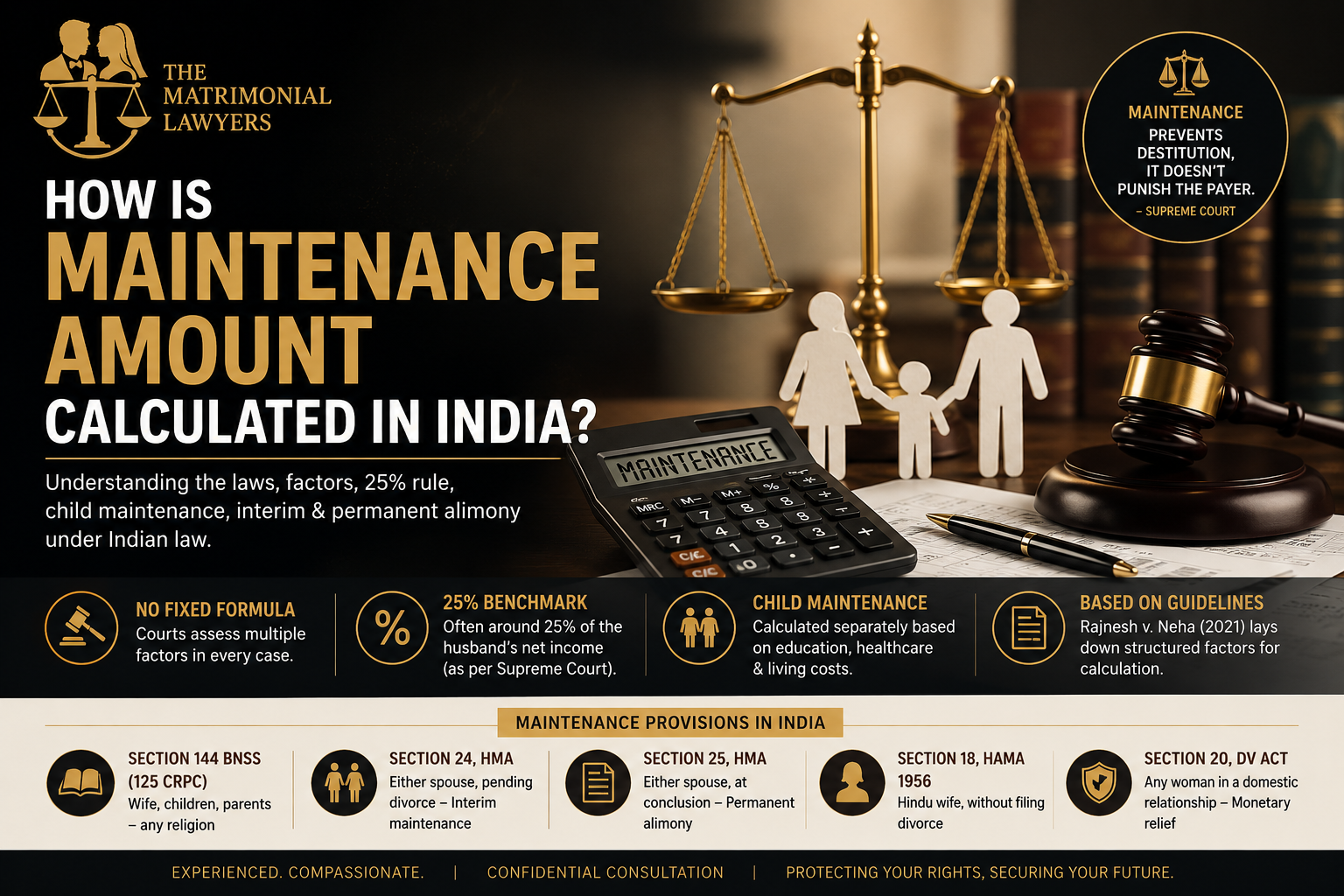
There’s no fixed maintenance calculation formula in Indian law. Courts weigh a structured set of factors — laid down by the Supreme Court in Rajnesh v. Neha (2021) — including both spouses’ income, the marital standard of living, and dependents on either side. As a rough benchmark, permanent alimony is often anchored around 25% of the husband’s net monthly income (Kalyan Dey Chowdhury v. Rita Dey Chowdhury, (2017) 14 SCC 200), adjusted up or down for children, the wife’s own income, and each spouse’s obligations.
“How Much Will I Have to Pay?”
That’s the question every client asks in the first five minutes — and its mirror, “how much can I actually get?”, comes just as often from the other side. There’s no calculator and no formula to plug numbers into. What exists is a well-defined set of factors, consolidated by the Supreme Court into structured guidelines in Rajnesh v. Neha (Criminal Appeal No. 730 of 2020). The Court anchored the purpose too: maintenance prevents destitution, it doesn’t punish the payer — so the figure sits between two extremes, neither oppressive nor penurious.
Which Law Governs Your Claim?
| Law | Who Can Claim | Forum | Relief |
| Section 144 BNSS (125 CrPC) | Wife, children, parents — any religion | Magistrate | Monthly; fastest route |
| Section 24, HMA | Either spouse, pending divorce | Family Court | Interim maintenance |
| Section 25, HMA | Either spouse, at conclusion | Family Court | Lump sum or monthly alimony |
| Section 18, HAMA 1956 | Hindu wife, without filing divorce | Civil/Family Court | Maintenance during marriage |
| Section 20, DV Act | Any woman in a domestic relationship | Magistrate | Monetary relief |
Other personal laws (Muslim, Christian, Parsi, Special Marriage Act) have their own provisions, but Section 144 BNSS/125 CrPC sits above all of them as a religion-neutral option, available regardless of the couple’s personal law.
The Core Factors
From Rajnesh v. Neha and the cases it consolidated — Jasbir Kaur Sehgal (1997) 7 SCC 7, Chaturbhuj v. Sita Bai (2008) 2 SCC 316, Manish Jain v. Akanksha Jain (2017) 15 SCC 801, Bharat Hegde v. Saroj Hegde, 140 (2007) DLT 16:
Wife’s side: status and standard of living during marriage; reasonable needs of herself and dependent children; education and professional qualifications; independent income, and whether it covers a comparable standard of living; whether she worked before or during the marriage, or sacrificed a career for the family; litigation costs if unemployed.
Husband’s side: actual income and financial capacity; reasonable personal expenses; other dependents he’s obliged to maintain (parents, a second family); existing liabilities.
One clarified point: the wife’s parents’ finances are irrelevant (Manish Jain v. Akanksha Jain) — courts won’t lower a husband’s liability because her family is well-off.
The “25% Rule” — and Its Limits
Kalyan Dey Chowdhury v. Rita Dey Chowdhury ((2017) 14 SCC 200) held that 25% of the husband’s net salary is just and proper as maintenance, following Dr. Kulbhushan Kumar v. Raj Kumari, (1970) 3 SCC 129. But it’s an anchor, not a rule: it applies to net, not gross, income; it was decided in a case without minor children, so the figure moves once children or other dependents enter the picture; and the same judgment reaffirms that maintenance always depends on the facts.
Illustration: a husband earning ₹1,20,000 net/month, non-working wife, no children — a court might anchor around ₹30,000 (25%). If the wife earns ₹40,000 herself, the figure drops well below that anchor rather than being denied outright (Chaturbhuj v. Sita Bai). Children add a separate, itemised amount for education and living costs — on top of, not blended into, the wife’s figure.
Interim vs. Permanent, and Lump Sum vs. Monthly
Interim maintenance is decided quickly, often on limited pleadings — Bharat Hegde v. Saroj Hegde confirms courts can draw reasonable inferences where income isn’t fully disclosed, and that Section 125 CrPC payments adjust against a later Section 24 HMA award. Permanent maintenance, decided after a full trial, is more precisely reasoned.
The structure also affects tax: monthly maintenance is taxable as income in the recipient’s hands, while a one-time lump sum settlement is a capital receipt and is not taxable — settled by the Bombay High Court in Princess Maheshwari Devi of Pratapgarh v. CIT, (1984) 147 ITR 258, and followed by the Delhi Tribunal in ACIT v. Meenakshi Khanna (ITAT Delhi, 2013). This is worth weighing with your lawyer and a CA before choosing a structure.
Hidden Income and Children
Where a spouse conceals real income, courts can estimate earning capacity from lifestyle, property, and spending patterns rather than accept a low declared figure — which is why Rajnesh v. Neha made a standardised Affidavit of Disclosure of Assets and Liabilities mandatory for both parties in every case.
Child maintenance is calculated separately from the wife’s figure — school fees, medical costs, and standard of living, adjusted for the child’s age — and continues regardless of the mother’s marital status later.
Special Situations
A woman in a bigamous marriage generally can’t claim maintenance as a “wife” under Section 125 CrPC/144 BNSS (Yamunabai Anantrao Adhav, (1988) 1 SCC 530) — unless the husband concealed his existing marriage, in which case she remains entitled even under that provision (Badshah v. Urmila Badshah Godse, (2014) 1 SCC 188). But that CrPC-specific bar doesn’t carry over to the Hindu Marriage Act: in 2025, a three-judge bench clarified that a spouse whose marriage is void can still claim interim and permanent alimony under Sections 24 and 25 HMA, since that remedy is legally distinct from Section 125 (Sukhdev Singh v. Sukhbir Kaur, 2025 INSC 197). Separately, a husband can claim maintenance from his wife where he genuinely cannot support himself due to disability and she has the means — rare, but not barred.
The Practical Range
- Interim maintenance for the wife alone: roughly one-fifth to one-quarter of net income.
- Permanent alimony: often anchors around 25% of net income with no minor children.
- With children, the combined figure moves higher, assessed component by component.
Treat these as orientation — the real number depends on the documents on record: the disclosure affidavit, salary slips, ITRs, bank statements, and evidence of the marital standard of living.
Frequently Asked Questions
Is there a legal formula for maintenance in India?
No fixed formula — courts apply Rajnesh v. Neha‘s factors, with the 25% net-income benchmark as a common reference point.
Gross or net income?
Net, after tax and PF. Courts have struck down orders applying 25% to gross salary.
Does the wife’s own income reduce the amount?
Yes, generally — proportionately, not through automatic denial, unless her income is minimal.
Is maintenance taxable?
Monthly maintenance is taxable as income; a lump sum settlement is a non-taxable capital receipt.
Is child maintenance part of the 25% figure?
No — it’s calculated separately, based on education, medical, and living costs.
The Bottom Line
Maintenance in India is built from a structured set of factors, not a fixed percentage — the 25% figure is a useful anchor, not a rule. Documentation decides the outcome: a well-supported financial affidavit, backed by real salary slips, ITRs, and bank statements, shapes the final number far more than any argument about fairness.
About the Author
Adv. Aman Chawla | Matrimonial Lawyer | Divorce & Family Law Specialist
Legal Disclaimer
This article is intended solely for informational and educational purposes and does not constitute legal advice. The legal position may vary depending upon the facts of each case, amendments in law, and judicial interpretation. Readers should seek independent legal advice before acting on any information contained herein. Reading this article or communicating through the website does not create an advocate-client relationship.
Written by Adv. Aman Chawla. This article is for informational purposes only and does not constitute legal advice. Every case is fact-specific. Please consult a qualified lawyer before taking any legal action.