Written by Adv. Aman Chawla | Matrimonial Law Specialist | Delhi High Court & Supreme Court of India 8 Years Exclusive Practice in Family & Matrimonial Law | Jangpura, New Delhi
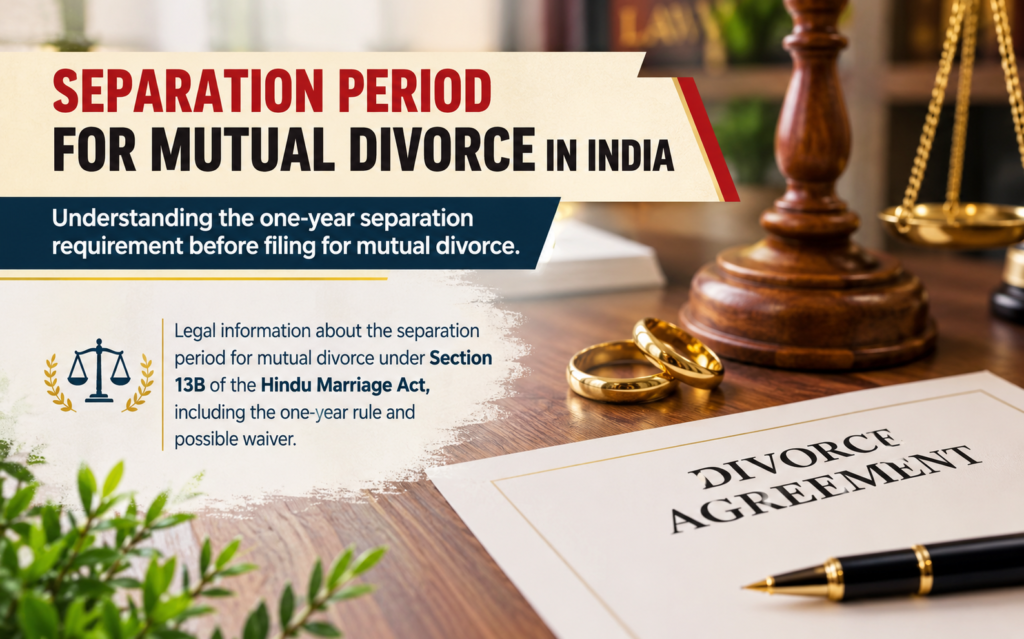
In this article, I will explain exactly what the separation period for mutual divorce means, how it is counted, whether you can live under the same roof, how to prove it, and when courts can waive it.
“Sir, we both want a divorce. But we are still in the same flat because of the EMI and the kids. Can we file mutual divorce?”
“Sir, she moved out only seven months ago. Do we have to wait until it becomes one year?”
These are two of the most common questions I get from couples who have agreed to part ways. Both partners are ready, the terms are mostly agreed, and then they hear about the “one-year separation” rule and feel stuck.
In this article, I will explain exactly what the separation period for mutual divorce means, how it is counted, whether you can live under the same roof, how to prove it, and when courts can waive it.
Quick Answer
Under Section 13B(1) of the Hindu Marriage Act, a couple can file a joint petition for mutual divorce if they have been living separately for one year or more and have mutually agreed that the marriage should be dissolved. “Living separately” means not living as husband and wife; it does not necessarily mean living in different houses (Supreme Court, Sureshta Devi v. Om Prakash, 1991). After filing, there is a six-month period before the second motion, which courts can waive in suitable cases (Amardeep Singh v. Harveen Kaur, 2017). A Full Bench of the Delhi High Court held in December 2025 that even the one-year separation can be waived in cases of exceptional hardship or depravity under the proviso to Section 14(1).
1. What Does the Law Actually Say?
Section 13B(1) HMA allows both spouses to file a petition together on the ground that:
- They have been living separately for a period of one year or more,
- They have not been able to live together, and
- They have mutually agreed that the marriage should be dissolved.
Separately, Section 14 says that no divorce petition can be presented within one year of the date of marriage, unless the court allows it on the ground of exceptional hardship to the petitioner or exceptional depravity on the part of the respondent.
Then, Section 13B(2) provides that the court will pass the decree on a second motion made not earlier than six months and not later than eighteen months after the first motion, if the petition has not been withdrawn.
So there are really three time periods people confuse:
- One year since marriage (Section 14)
- One year of living separately before filing (Section 13B(1))
- Six months between the first and second motions (Section 13B(2))
2. What Does “Living Separately” Mean? Can We Be Under the Same Roof?
This is the most important question, and the Supreme Court answered it more than three decades ago.
In Sureshta Devi v. Om Prakash (Supreme Court, 7 February 1991), the Court held that “living separately” connotes not living like husband and wife. It has nothing to do with the place of living. Spouses may live under the same roof and still be living separately, if they have lost the wish to perform marital obligations, and this state must have existed for the one year immediately before the petition is filed.
So yes, you can be in the same house and still meet this requirement, if you are living as two separate people: separate rooms, no marital relationship, separate lives, often staying together only for the children or because of a home loan.
Real-life example: Kunal and Ritika live in their jointly owned flat in Gurugram. For the last 14 months, they have slept in separate rooms, stopped going out together, split household expenses and stopped any marital relationship. They stayed on in the same flat because both pay the EMI and their daughter is in Class 5. When they file for mutual divorce, they can state that they have been living separately since August of last year, even though their address is the same. What matters is the nature of the relationship, not the address.
A word of caution: if you are under the same roof, be clear and consistent in the petition and in your statements about when the separation started and what it looked like. The court will want to be satisfied that it is genuine.
3. How Is the One Year Counted?
- It is counted backwards from the date you file the first motion petition.
- It must be continuous separation for at least one year immediately before filing.
- Short reconciliation attempts or meeting for children’s events generally do not break it, but living together again as husband and wife for a period may restart the clock.
- The date you separated should be stated clearly in the petition.
4. How Do You Prove the Separation?
In a mutual divorce, both parties state the date of separation in their joint petition and their affidavits, so detailed proof is usually not demanded. But it helps to be consistent and to have something to support it:
- Rent agreement or address proof showing one spouse moved out
- Messages around the time of separation
- Separate bank accounts or expense arrangements
- If under the same roof: an honest description in the petition of how you have lived separately
Never invent a date to meet the one-year rule. A false statement in a sworn petition can come back to haunt you, especially if one party later withdraws consent and the dispute becomes contested.
5. Can the Six-Month Cooling Period Be Waived?
Yes. In Amardeep Singh v. Harveen Kaur (Supreme Court, 12 September 2017), the Court held that the six-month period under Section 13B(2) is directory, not mandatory, and can be waived by the court where:
- The parties have already been living separately for more than the combined period (one year and six months) before the first motion
- All efforts at mediation and reconciliation have failed
- The parties have genuinely settled all issues, including alimony and custody
- The waiting period would only prolong their agony
The application for waiver can be filed one week after the first motion. Even then, waiver is at the court’s discretion.
In Delhi, where the parties have been separated for a long time and everything is settled, Family Courts regularly waive this period. I have explained the whole timeline in my article on how long a mutual divorce takes in India.
6. Can the One-Year Separation Itself Be Waived?
For years, this was a grey area. Some judges held that Section 13B is a complete code and the one-year separation cannot be relaxed at all.
In December 2025, a Full Bench of the Delhi High Court (2025:DHC:11467-FB, reported as Shiksha Kumari v. Santosh Kumar) settled the question for Delhi. It held that:
- The one-year separation under Section 13B(1) is a prerequisite for the first motion, but it can be waived by applying the proviso to Section 14(1) HMA.
- Waiver is not automatic. It is allowed only on exceptional hardship or exceptional depravity, and the court must be satisfied that the consent is free and well-considered.
- Waiver of the one-year period and waiver of the six-month cooling period are considered independently, and where both are waived, the decree can take effect immediately.
Real-life example: Sneha and Arjun married in February. Within weeks, it became clear the marriage could not work; they never really lived together as a couple. Both are in their twenties, both want to move on, and there are no children or financial disputes. Previously, they might have been told to wait out the year. After the Full Bench ruling, they can apply in Delhi for waiver on grounds of exceptional hardship, explaining why waiting would cause real harm. The court will still examine whether the hardship is genuinely exceptional.
7. Can Either Spouse Back Out During the Separation or Waiting Period?
Yes. In Sureshta Devi, the Supreme Court also held that mutual consent must continue until the decree is passed. If either spouse withdraws consent before the decree, the court cannot grant a mutual divorce.
This is why I always advise clients to finalise every term (alimony, stridhan, custody, withdrawal of cases) in writing before the first motion, and to structure payments so that the bulk is paid at the second motion. I have written separately on whether mutual divorce can be withdrawn after filing.
8. What If You Do Not Meet the One-Year Requirement?
You have a few options:
- Wait until the one-year separation is complete, then file. Use the time to finalise the settlement.
- In exceptional cases, apply for waiver under Section 14 (as explained by the Delhi High Court Full Bench).
- Where there are genuine grounds such as cruelty, file a contested divorce, which does not require one year of separation before filing (though Section 14 still applies within the first year of marriage).
- In rare cases where the marriage has completely broken down, the Supreme Court has the power under Article 142 to dissolve marriages, as held by the Constitution Bench in Shilpa Sailesh v. Varun Sreenivasan (2023).
Frequently Asked Questions
Q: What is the separation period for mutual divorce in India?
A: One year or more of living separately before filing the first motion under Section 13B(1) HMA, followed by a six-month period before the second motion, which can be waived in suitable cases.
Q: If husband and wife are not living together for 1 year, can they file mutual divorce?
A: Yes, if both agree that the marriage should be dissolved and they have been living separately for one year or more immediately before filing.
Q: Can we live in the same house and still file mutual divorce?
A: Yes. The Supreme Court in Sureshta Devi held that living separately means not living as husband and wife, not necessarily living in different houses.
Q: Can the one-year separation be waived?
A: In Delhi, the High Court Full Bench (December 2025) held it can be waived in cases of exceptional hardship or depravity under Section 14(1). Courts elsewhere may take their own view.
Q: Can the six-month cooling-off period be waived?
A: Yes, under Amardeep Singh v. Harveen Kaur (2017), if the conditions are met and the court is satisfied.
Q: Does the separation have to be continuous?
A: Yes, generally one continuous year immediately before filing. Resuming married life together may restart the period.
Q: Do we need documents to prove separation?
A: Usually the joint petition and affidavits are enough, but supporting documents help, and the dates you give must be truthful and consistent.
Adv. Aman Chawla’s Practical Note
The one-year rule causes more anxiety than it should. Most couples I advise are surprised to learn that living separately does not mean living in separate houses, and that the six-month cooling period is often waived in Delhi.
My advice is to use the separation year wisely. Settle the terms, document them, decide on custody and finances, and keep communication civil. Couples who walk into the first motion with everything settled often walk out with a divorce within weeks. Couples who file the day the year ends, without a settlement, often end up back in contested litigation.
Final Words
The separation period is not meant to punish couples; it is meant to make sure the decision to divorce is considered and final. Understand what “living separately” really means, count your year correctly, settle everything in writing, and know when waivers are possible. That is how a mutual divorce stays quick, clean and dignified.
Consult Adv. Aman Chawla, Matrimonial Law Specialist, practicing before the Supreme Court of India, Delhi High Court, and all Delhi District Courts. Available for urgent matters, outstation clients, and online consultations across India.
Call: +91-8076836899 | WhatsApp | Email: info@thematrimoniallawyers.com Office: O-11A Basement, Jangpura Extension, New Delhi – 110014
Written by Adv. Aman Chawla This article is for informational purposes only and does not constitute legal advice. Every case is fact-specific. The examples in this article are illustrative and names and details have been changed or simplified. Please consult a qualified lawyer before taking any legal action.