Written by Adv. Aman Chawla | Matrimonial Law Specialist | Delhi High Court & Supreme Court of India | 8 Years Exclusive Practice in Family & Matrimonial Law | Jangpura, New Delhi
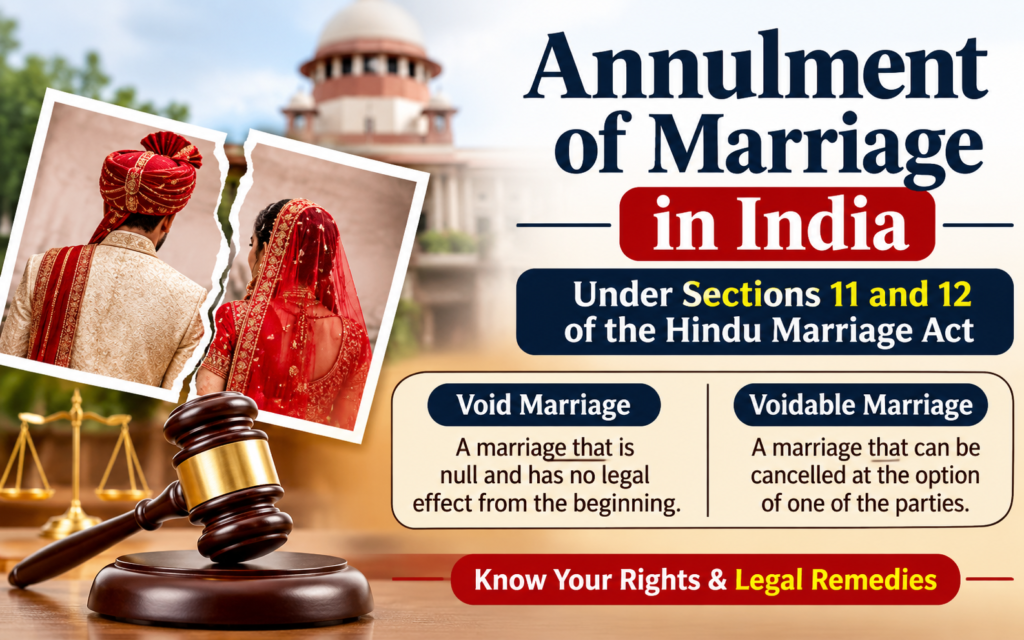
Annulment of marriage in India is a legal process through which a court declares a marriage void or voidable under specific provisions of the Hindu Marriage Act, 1955.
“Sir, we got married four months ago and the marriage was never consummated. Do I have to wait a year to file for divorce?”
“Sir, I just found out my husband was already married when he married me. Is my marriage even valid?”
Many people use “annulment” and “divorce” as if they mean the same thing. They do not. A divorce ends a valid marriage. An annulment (legally, a decree of nullity) declares that the marriage was never valid or had a defect from the start.
This difference is more than technical. It affects the waiting period, the evidence you need, and the time limits you must follow. It can also affect your right to maintenance. This article explains void and voidable marriages under the Hindu Marriage Act, 1955. It uses simple language and real-life examples.
Quick Answer
A void marriage under Section 11 HMA has no legal validity from day one. For example, one spouse may already have a living husband or wife. The parties may also fall within prohibited degrees or be sapindas, unless custom permits the marriage.
A voidable marriage under Section 12 HMA remains valid until a court annuls it. Grounds include non-consummation due to impotence, consent obtained through force or fraud, certain mental disorders, or the wife’s pregnancy by another man at the time of marriage.
Annulment grounds concern defects that existed when the parties married. The one-year bar under Section 14 does not apply to nullity petitions. Children of void and voidable marriages are legitimate under Section 16. In 2025, the Supreme Court also held that a spouse in a marriage declared void can claim permanent alimony and interim maintenance.
1. Divorce and Annulment: The Basic Difference
- Divorce ends a valid marriage because of events after the wedding. These may include cruelty, desertion or adultery under Section 13 HMA. Spouses can also seek divorce by mutual consent under Section 13B.
- Annulment deals with a defect that existed when the parties married. The law treats the marriage as void, or allows the affected spouse to seek its cancellation as a voidable marriage.
- Under Section 14, a person generally cannot file a divorce petition within one year of marriage. The court may allow an earlier petition in exceptional cases involving hardship. A nullity petition does not face this same one-year bar. That is why annulment may offer a faster remedy during the first year.
2. Void Marriages Under Section 11
Section 5 of the Hindu Marriage Act sets out the conditions for a valid Hindu marriage. Under Section 11, a marriage becomes void if it breaks any of these three conditions:
- Bigamy: Either party had a living spouse at the time of the marriage (Section 5(i)).
- Prohibited degrees: The parties fall within the degrees of prohibited relationship. The law allows an exception if the custom or usage governing both permits the marriage (Section 5(iv)).
- Sapinda relationship: The parties are sapindas of each other. The law allows an exception if their custom permits the marriage (Section 5(v)).
A void marriage has no legal existence. You do not strictly need a decree to make it void. However, you should seek a court declaration of nullity in practice. The order can help with official records, remarriage, property matters and future disputes.
Real-life example: Neha married Vikram in 2023 in an arranged marriage. In 2025, a woman approached Neha and claimed to be Vikram’s wife. She also showed a 2018 marriage certificate. Vikram had never obtained a divorce from his first wife. Neha’s marriage is void under Section 11. She can seek a declaration of nullity. She can also consider a criminal complaint for bigamy against Vikram. As explained below, the void marriage does not automatically leave her without financial remedies.
3. Voidable Marriages Under Section 12
A voidable marriage remains valid until one spouse approaches the court and obtains an annulment. Section 12(1) lists these grounds:
- Non-consummation due to impotence: The marriage has not been consummated because of the respondent’s impotence.
- Mental disorder: At the time of marriage, the other party could not give valid consent due to unsoundness of mind. This ground also covers a mental disorder of such a kind or extent that makes the person unfit for marriage and procreation of children. The conditions under Section 5(ii) also apply.
- Force or fraud: Someone obtained the petitioner’s consent through force or fraud. The fraud must concern the nature of the ceremony or a material fact or circumstance about the respondent. The rule also covers the guardian’s consent where the law requires it.
- Pregnancy by another man: The wife was pregnant by someone other than the husband when they married.
Strict Time Limits and Conditions Under Section 12(2)
The law sets specific limits for certain annulment grounds:
- Force or fraud: You must file the petition within one year after the force ends or you discover the fraud. You must also avoid living with the other party as husband or wife, with full consent, after that point.
- Pregnancy by another man: The husband must have been unaware of the pregnancy when the parties married. He must file the petition within one year of the marriage. He must also avoid marital intercourse with his consent after discovering the fact.
Courts apply these limits strictly. If you continue living together after discovering fraud, you may lose the right to seek annulment. A delay beyond the one-year limit may also affect your claim. You may then need to consider divorce instead.
Real-life example: Before Rohit’s wedding, his family said that his wife Ananya held an MBA and worked at a multinational company. A month after the wedding, he learned that she had neither the degree nor the job. He also learned that her family knew this.
Whether this amounts to fraud about a material fact depends on the circumstances. Courts examine how important the misrepresentation was to the person’s consent. Not every lie qualifies. If Rohit wants to rely on fraud, he must file within one year of discovering it. He should also avoid continuing to live with her as husband and wife after discovering the facts.
Another real-life example: Simran’s marriage had not been consummated during the eight months after the wedding. Her husband refused a medical examination and avoided the subject. She does not have to wait for the one-year period that applies to divorce. She can seek annulment on the ground of non-consummation due to impotence. Medical evidence will matter. The husband’s refusal to undergo an examination may also become relevant.
4. Is Alimony Payable If the Marriage Is Void?
For many years, courts disagreed on this issue. Some held that a “wife” in a void marriage had no right to alimony. Their reasoning was that the law did not recognise the marriage as valid.
In Sukhdev Singh v. Sukhbir Kaur (Supreme Court, three-judge bench, February 2025), the Court settled the question. It held that:
- A spouse can claim permanent alimony or maintenance under Section 25 HMA, even after the court declares the marriage void under Section 11. The court will consider the facts and conduct of the parties. The relief remains discretionary.
- A court can also grant interim maintenance under Section 24 HMA during the proceedings. The applicant must meet the conditions of that section.
- The Court strongly disapproved of terms such as “illegitimate wife” or “faithful mistress” for a woman in a void marriage. It called such language a violation of her dignity.
This ruling offers important protection to women who unknowingly married a man who already had a wife. I have explained the rules for permanent alimony after divorce in a separate article.
A word of caution: Maintenance under Section 144 BNSS (old Section 125 CrPC) requires a legally wedded “wife”.
In Yamunabai Anantrao Adhav v. Anantrao Shivram Adhav (Supreme Court, 1988), the Court held that a woman in a void bigamous marriage could not claim maintenance under Section 125.
However, Badshah v. Urmila Badshah Godse (Supreme Court, 2013) dealt with a different situation. The husband had concealed his first marriage and deceived the woman. The Court held that he could not take advantage of his own wrong, and she could claim maintenance. Therefore, the facts matter. In particular, the court will consider whether the woman knew about the first marriage.
5. What About the Children?
The law protects children of void and voidable marriages. Under Section 16 HMA, a child born from a void marriage remains legitimate. The same rule applies to a child from a voidable marriage that the court later annuls.
In Revanasiddappa v. Mallikarjun (Supreme Court, 1 September 2023), a three-judge bench explained the property rights of such children. The Court held that they can claim a share in their parents’ property. This includes the share their parent would have received in a notional partition of Hindu joint family (coparcenary) property. However, they do not become coparceners in their own right.
Therefore, annulment or divorce does not affect the children’s legitimacy, custody rights or maintenance.
6. Annulment or Divorce: Which Should You Choose?
Choose carefully. The facts you present in court must support the remedy you seek.
- If the defect existed at the time of marriage and you meet the time limits, annulment may offer a faster remedy. It also avoids the Section 14 one-year bar.
- If the marriage was valid but later broke down due to cruelty, desertion or other conduct, divorce may be the right remedy.
- If both spouses agree to separate, mutual divorce may be the quickest option. However, remember the one-year separation requirement. I have explained the options for short marriages in my article on mutual divorce before one year when the couple never lived together.
- In some cases, lawyers plead annulment and, in the alternative, divorce on grounds of cruelty. This approach can help protect the case if the court does not accept one of the grounds.
7. Common Mistakes
- Delaying action after discovering fraud: The one-year limit is strict. Continuing to live together can also defeat the claim.
- Treating a void marriage as “nothing” and remarrying: Always obtain a court declaration first. Without it, you may face questions about your second marriage. Read more about remarrying before a divorce becomes final.
- Assuming that maintenance is impossible: After Sukhdev Singh (2025), courts can grant alimony even in void marriages. The court will still consider its discretion and the facts.
- Pleading vague fraud: Courts need clear proof of what someone concealed or misrepresented. You must also explain why that fact mattered.
Frequently Asked Questions
Q: What is the difference between annulment and divorce in India?
A: Divorce ends a valid marriage for reasons that arise after the wedding. Annulment declares a marriage void or cancels a voidable marriage. It deals with a defect that existed when the parties married.
Q: Can I file for annulment within one year of marriage?
A: Yes. The one-year bar under Section 14 applies to divorce petitions, not nullity petitions. In fact, some annulment grounds have their own one-year filing limit.
Q: Is a second marriage during the first marriage valid?
A: No. Section 11, read with Section 5(i) HMA, treats it as void. The act may also amount to the criminal offence of bigamy.
Q: Can a wife get alimony if the marriage is declared void?
A: Yes. In Sukhdev Singh v. Sukhbir Kaur (2025), the Supreme Court held that courts can grant permanent alimony under Section 25 and interim maintenance under Section 24. The facts of the case will determine the relief.
Q: Is non-consummation of marriage a ground for annulment?
A: Yes, if the respondent’s impotence caused the non-consummation (Section 12(1)(a)).
Q: Are children of a void marriage legitimate?
A: Yes. Section 16 HMA protects their legitimacy. They can also inherit their parents’ property, including the parent’s share in coparcenary property, as explained in Revanasiddappa v. Mallikarjun (2023).
Q: What is the time limit for annulment on the ground of fraud?
A: You must file within one year of discovering the fraud. You must also avoid continuing to live together as husband and wife with full consent after discovering it.
Adv. Aman Chawla’s Practical Note
Clients often approach me during the first few months of marriage. They feel trapped and believe they must wait a full year before taking any legal step. In many cases, the facts may actually support annulment. This remedy does not carry the same one-year waiting period as divorce.
However, annulment has strict timing rules. If you discover fraud, a concealed earlier marriage or a serious concealed condition, record the date. Preserve all available proof and seek legal advice.
Do not continue living together “to see if things improve” if you intend to rely on fraud. That decision alone may close the door to an annulment claim.
Final Words
Annulment and divorce both end a marriage, but they rest on different legal grounds. You need to understand whether your marriage is void, voidable or valid. That decision helps you choose the right remedy and understand how quickly you can act. It also helps you protect your rights to maintenance and your children’s rights.
Choose the right remedy at the start. You may save yourself years of avoidable litigation.
Consult Adv. Aman Chawla, Matrimonial Law Specialist, practicing before the Supreme Court of India, Delhi High Court, and all Delhi District Courts. Available for urgent matters, outstation clients, and online consultations across India.
Call: +91-8076836899 | WhatsApp | Email: info@thematrimoniallawyers.com
Office: O-11A Basement, Jangpura Extension, New Delhi – 110014
Written by Adv. Aman Chawla. This article is for informational purposes only and does not constitute legal advice. Every case is fact-specific. The examples in this article are illustrative; names and details have been changed or simplified. Please consult a qualified lawyer before taking any legal action.