
How Do Courts Calculate the Income of a Self-Employed Husband in Maintenance Cases? (India)

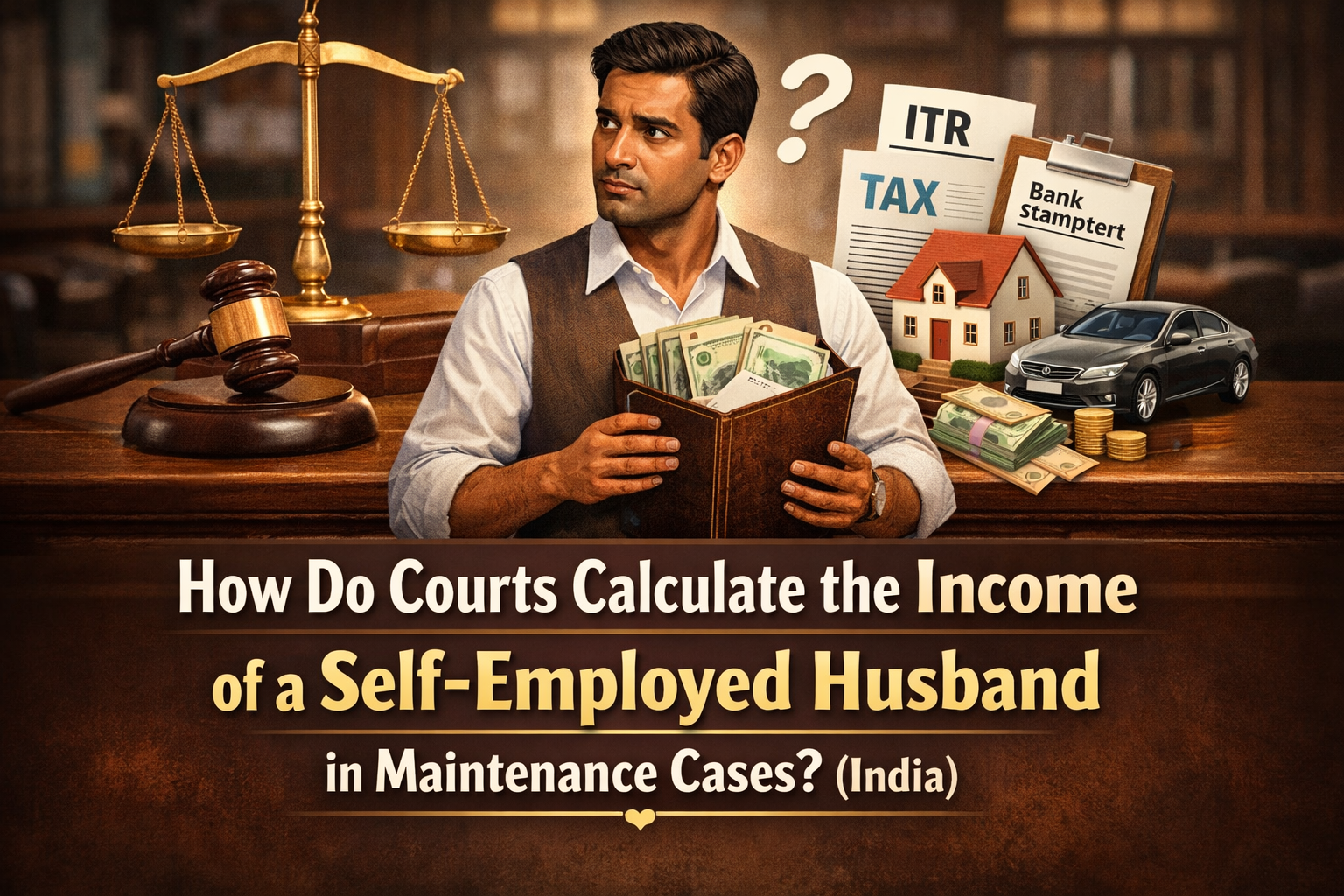
In maintenance proceedings, one of the most challenging aspects is determining the income of a husband who is self-employed or running a business. Unlike salaried individuals, there are no fixed salary slips or standardised proof of earnings. This often leads to confusion among litigants about how courts arrive at a fair figure. The reality is that courts in India follow a holistic and practical approach to assess income in such cases. maintenance calculation India
At the outset, it is important to understand that there is no straight formula for calculating the income of a self-employed individual. Courts examine a combination of financial documents and surrounding circumstances to determine the actual earning capacity, rather than relying solely on declared figures. income calculation in divorce cases
Typically, courts scrutinise documents such as Income Tax Returns (ITRs), bank account statements, profit and loss accounts, balance sheets, and even credit card statements. These documents provide a financial snapshot, but they are not treated as conclusive proof. It is a settled position that ITRs alone cannot be blindly relied upon, especially where there is a possibility of underreporting.
In fact, if the court suspects that income is being concealed, it is well within its powers to reject the declared income and draw an adverse inference against the husband. This means that lack of transparency or incomplete disclosure can actually work against the party and result in a higher assessment of income.
An equally important factor considered by courts is the lifestyle and standard of living of the husband. Courts often rely on the principle that financial reality can be gauged through conduct and lifestyle. For instance, the type of residence, vehicles used, travel habits, and general expenditure patterns are closely examined. If there is a visible mismatch between the declared income and the lifestyle being maintained, courts may conclude that the real income is significantly higher than what is disclosed.
In such situations, courts are also permitted to apply a degree of reasonable guesswork. Judicial precedents have recognised that in cases involving self-employed individuals, exact income may not always be ascertainable through documents alone. Therefore, courts can rely on surrounding circumstances, probabilities, and overall financial conduct to arrive at a just figure.
A practical illustration highlights this approach. In one case, the husband claimed that he was unemployed and had no independent source of income. However, it was brought on record that he was residing in a 500 square yard property in Punjabi Bagh, Delhi, and was using a luxury car such as a BMW, although these assets were shown in his father’s name. It was argued that he was actively involved in managing the family business and was enjoying a high standard of living.
Taking into account the lifestyle, background, and indirect indicators of income, the court did not accept the claim of zero income. Instead, it assessed his financial capacity on a broader basis and granted maintenance of ₹43,000 per month.
This clearly demonstrates that courts are not restricted to formal documentation. Their primary objective is to uncover the true financial position of the parties to ensure a fair outcome.
In conclusion, in cases involving self-employed husbands, courts adopt a comprehensive and reality-based approach. They consider documents, lifestyle, and overall circumstances, and are willing to go beyond declared income where necessary. For any husband facing such proceedings, it is crucial to maintain complete transparency and proper financial records, as any attempt to conceal income can lead to adverse consequences.
Quick FAQs
How does the court calculate income if I am self-employed?
Courts assess income through multiple sources, such as ITRs, bank statements, business records, and overall financial conduct.
Are Income Tax Returns (ITRs) enough to prove my income?
No. ITRs are important but not conclusive. Courts may look beyond them.
Can the court reject my declared income?
Yes. If the court suspects concealment, it can disregard declared income and draw an adverse inference.
Does lifestyle matter in maintenance cases?
Yes. Courts closely examine lifestyle, including house, car, and spending patterns.
What if my assets are in my father’s or family member’s name?
Courts may still consider your actual control, usage, and lifestyle while assessing income.
Can the court assume income even if I show no earnings?
Yes. Courts can use reasonable estimation (guesswork) based on surrounding circumstances.
What is “adverse inference” in such cases?
It means the court may assume a higher income if you fail to disclose true financial details.
Will managing a family business be considered as income?
Yes. Active involvement in family business can be treated as a source of earning capacity.
Can maintenance be granted even without exact proof of income?
Yes. Courts can decide based on probabilities and available evidence.
What is the key advice for self-employed husbands?
Maintain transparency and proper records, as concealment can lead to higher maintenance liability.
Written by Adv. Aman Chawla, practising in Delhi, focuses on matrimonial and family law matters.