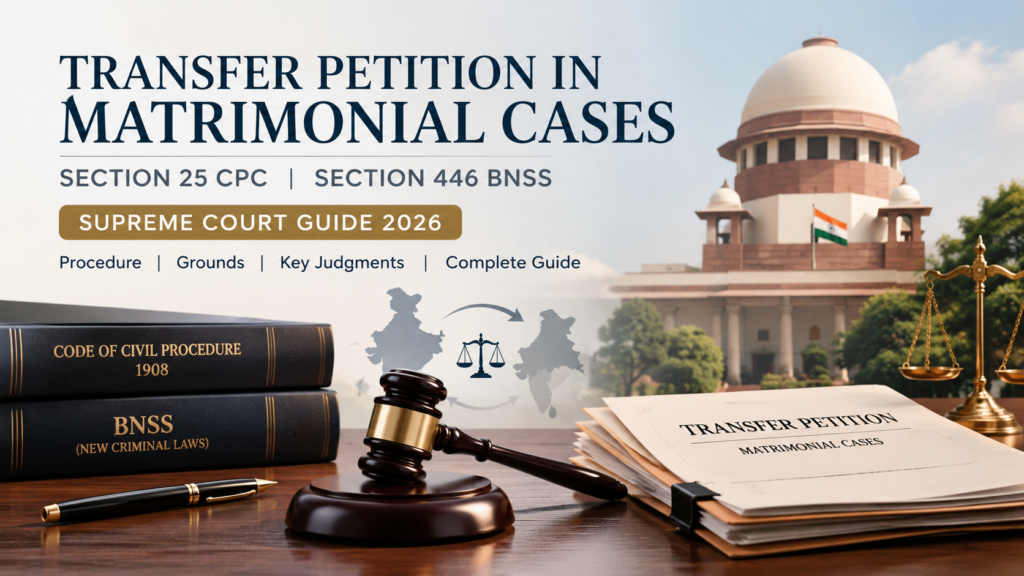
Transfer Petition in Matrimonial Cases (2026): When Distance Becomes a Legal Strategy


Introduction
In today’s fast-paced and mobile world, marriages often span across cities, states, and even countries. When disputes arise, the question is not just whether to fight a case, but where to fight it. This is where a transfer petition in matrimonial cases becomes a powerful legal tool.
A transfer petition allows a party to request the court to shift a case from one jurisdiction to another—ensuring fairness, convenience, and access to justice. In 2026, with increasing digital hearings and evolving legal interpretations, transfer petitions are not just procedural—they are strategic.
A transfer petition is a legal application filed before a higher court (usually the Supreme Court or High Court) seeking the transfer of a matrimonial case from one court to another.
This typically arises when:
- Husband and wife live in different cities
- One party faces difficulty attending court proceedings
- There is a safety concern or financial limitation
The goal is simple: ensure justice without undue hardship.
Why Transfer Petitions Are Trending in 2026
Transfer petitions have gained momentum due to:
- Rise in Inter-City & NRI Marriages
Couples today often live in different cities or countries, leading to jurisdictional conflicts.
- Increased Awareness of Legal Rights
More individuals—especially women—are aware that they can request case transfers for convenience.
- Digital Evidence & Remote Work Culture
With courts accepting digital evidence and hybrid hearings, the question of location has become even more strategic.
- Focus on Fair Trial
Courts now emphasize equal opportunity and accessibility for both parties.
When Can You File a Transfer Petition?
You can file a transfer petition in matrimonial cases under the following circumstances:
✔ Convenience of the Wife
Courts often prioritize the wife’s convenience, especially if she:
- Is unemployed
- Has custody of a child
- Lives far from the original court
✔ Financial Constraints
If traveling repeatedly to another city is financially burdensome.
✔ Safety Concerns
If there is a threat or harassment from the opposite party.
✔ Health Issues
Medical conditions that make travel difficult.
✔ Multiple Cases in Different Courts
To avoid conflicting judgments, courts may consolidate cases in one location.
Legal Provisions Governing Transfer Petitions
Transfer petitions in matrimonial cases are governed by:
- Section 25 of the Code of Civil Procedure (CPC) – Transfer by Supreme Court
- Section 24 of CPC – Transfer by High Court
These provisions empower higher courts to transfer cases in the interest of justice.
How to File a Transfer Petition (Step-by-Step)
Step 1: Hire a Matrimonial Lawyer
A skilled lawyer helps draft a strong petition highlighting valid grounds.
Step 2: Draft the Petition
The petition must include:
- Details of both parties
- Case information
- Reasons for transfer
Step 3: File in Appropriate Court
- Supreme Court (inter-state transfer)
- High Court (within the same state)
Step 4: Notice to Opposite Party
The court issues notice and hears both sides.
Step 5: Court Decision
Based on facts and fairness, the court allows or rejects the petition.
Important Factors Courts Consider
Courts do not approve transfer petitions blindly. They evaluate:
- Genuine hardship vs inconvenience
- Distance between courts
- Financial condition of parties
- Child custody responsibilities
- Safety and well-being
In many cases, the convenience of the wife is given preference, as observed in various judgments.
Strategic Importance of Transfer Petitions
A transfer petition is not just about location—it can impact:
Case Outcome
Better access to legal support improves your chances.
Cost Efficiency
Reduces travel and accommodation expenses.
Mental Peace
Less stress from frequent travel and logistical challenges.
Case Speed
Easier attendance leads to faster proceedings.
Common Mistakes to Avoid
Avoid these errors while filing a transfer petition:
- Filing without valid grounds
- Providing weak or generic reasons
- Ignoring proper documentation
- Delaying the filing process
A poorly drafted petition can lead to rejection.
Transfer Petition vs Video Conferencing: What’s Better?
With courts allowing virtual hearings, many wonder:
Why file a transfer petition at all?
Video Conferencing Works When:
- Both parties agree
- Case is at an early stage
- No serious disputes exist
Transfer Petition is Better When:
- Physical presence is required
- Evidence needs to be examined
- Safety or power imbalance exists
In 2026, both options coexist, but transfer petitions remain crucial in complex cases.
Real-Life Scenario
Imagine a wife living in Delhi with a young child while her husband files a divorce case in Mumbai. Attending hearings regularly becomes expensive and exhausting.
By filing a transfer petition, she can request the court to shift the case to Delhi—ensuring convenience and fairness.
Why You Need an Expert Matrimonial Lawyer
Transfer petitions require:
- Strong legal drafting
- Knowledge of precedents
- Strategic presentation
An experienced matrimonial lawyer ensures:
- Proper documentation
- Strong arguments
- Higher chances of approval
Conclusion
A transfer petition in matrimonial cases is more than a procedural request—it is a strategic move to ensure justice is accessible, fair, and practical.
In 2026, as legal systems evolve with technology and changing social dynamics, transfer petitions continue to play a vital role in matrimonial disputes. Whether it’s about convenience, safety, or financial constraints, the right legal approach can significantly impact your case.
If you are facing jurisdiction challenges in your matrimonial matter, seeking timely legal advice can help you make the right move—at the right time.
FAQ
FAQ
Q1. What is a transfer petition in matrimonial cases?
It is a legal request to shift a case from one court to another for convenience or fairness.
Q2. Who can file a transfer petition?
Either husband or wife can file, but courts often prioritize the wife’s convenience.
Q3. How long does it take?
It may take a few weeks to a few months depending on the court.
Q4. Can transfer petitions be rejected?
Yes, if the court finds no valid grounds.
Q5. Is a lawyer necessary?
Yes, professional legal drafting significantly increases approval chances.
Consult Adv. Aman Chawla, Matrimonial Law Specialist practising before the Supreme Court of India, High Court of Delhi, and all Delhi District Courts. Based in Delhi. Available for urgent matters, outstation clients, and online consultations across India.