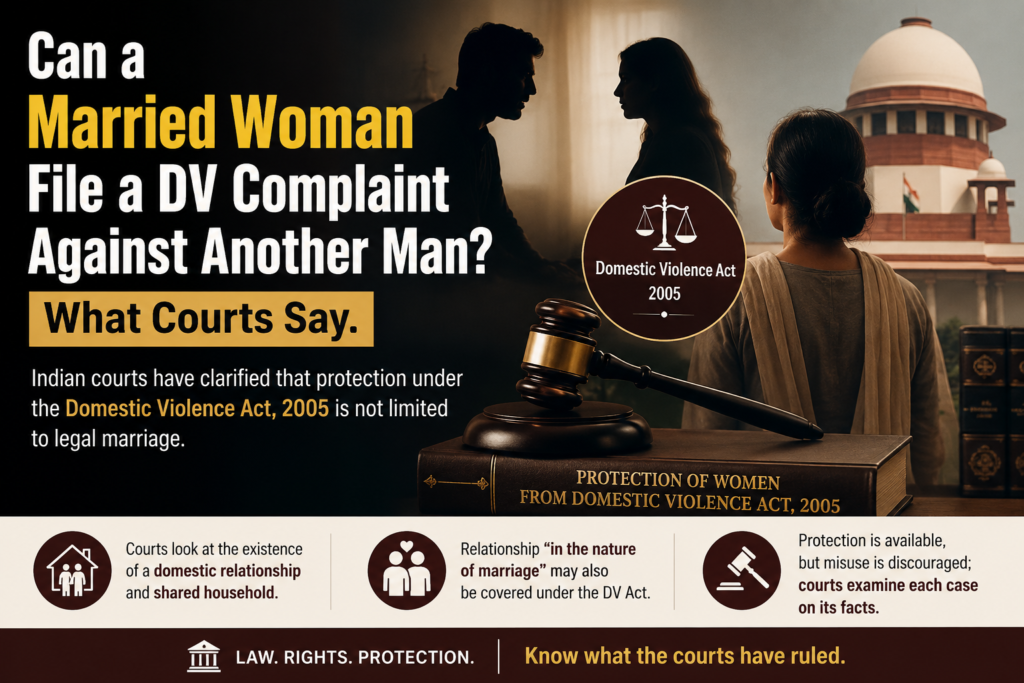
A critical judicial ruling clarifies that a legally married woman who has never lived in a shared household with the petitioner cannot invoke the Domestic Violence Act — and proceedings under Section 12 are liable to be quashed.
Written by Adv. Aman Chawla | Matrimonial Law Specialist | Delhi High Court & Supreme Court of India 8 Years Exclusive Practice in Family & Matrimonial Law | Jangpura, New Delhi
The Question That Matters
In matrimonial disputes across India, the Protection of Women from Domestic Violence Act, 2005 (“DV Act”) is frequently invoked — sometimes beyond its intended scope. One of the most contested situations arises when a legally married woman, without any divorce, files a DV complaint against a man she claims to have lived with in a relationship akin to marriage. Can such a complaint be sustained in law?
Courts have now answered this with clarity — and the answer is No.
What the Law Actually Requires
The DV Act protects women who are in a “domestic relationship,” defined under Section 2(f) as two persons who live or have lived together in a shared household — whether as spouses, in a relationship akin to marriage, or as family members.
The operative phrase is “lived together in a shared household.” This is not a procedural formality — it is the very foundation of jurisdiction under the Act. Without proof of shared cohabitation, there is no domestic relationship, and without a domestic relationship, there is no valid complaint.
“Living together with another person in a shared household is an essential ingredient of domestic relationship as contemplated under Section 2(f) of the DV Act.”— From the judicial ruling discussed in this article.
The Judicial Ruling: Key Facts
The case arose from a writ petition filed under Article 226 of the Constitution seeking to quash a complaint lodged under the DV Act and an interim maintenance order granted by the Magistrate. The petitioner argued — and the court agreed — that:
- The respondent had never claimed to be living together with the petitioner.
- She had also not claimed to have ever lived with the petitioner before filing the application.
- She was an admitted married woman who had not obtained any legal divorce from her husband.
- The proceedings under Section 12 of the DV Act were therefore unsustainable in law.
The court allowed the petition, quashing both the complaint and the impugned order of the Magistrate.
Why a Currently Married Woman Cannot Invoke This Provision
The court’s reasoning rests on a straightforward but important distinction:
If a woman is claiming to be in a relationship akin to marriage with a man, she must also have lived in a shared household with him. More importantly, if she is already a legally married woman — and remains married without a legal divorce — she cannot simultaneously enter into a valid domestic relationship with another man for the purposes of the DV Act.
This prevents the misuse of the DV Act in situations where there is no genuine shared domestic life, and where invoking the law would amount to recognising a relationship that is legally impermissible.
Practical Implications for Your Case
If you are facing a DV complaint and any of the following apply, the complaint may be legally vulnerable to challenge:
- The complainant has never resided with you in a shared household.
- The complainant is a legally married woman with a subsisting marriage and no decree of divorce.
- There is no evidence of cohabitation either before or at the time of the complaint.
- The complaint was filed solely to obtain maintenance without a foundation in domestic relationship.
In such circumstances, a writ petition under Article 226/227 of the Constitution or an application under Section 528 of the BNSS, 2023 (formerly Section 482 CrPC) may be the appropriate remedy to seek quashing of proceedings.
Frequently Asked Questions
Can a DV complaint be quashed by the High Court?
Yes. Under Article 226/227 of the Constitution and Section 528 of the BNSS, 2023 (formerly Section 482 CrPC), the High Court has the power to quash complaints — including DV Act proceedings — where they are found to be legally unsustainable or an abuse of process.
Is shared household proof mandatory to file under the DV Act?
Yes. Courts have consistently held that living together in a shared household is an essential ingredient of a “domestic relationship” under Section 2(f) of the DV Act. Without evidence of this, proceedings cannot be sustained.
What if the complainant claims a “live-in” relationship but is already married?
Courts have held that a woman who is legally married and has not obtained a divorce cannot claim a valid domestic relationship akin to marriage with another man. Proceedings based on such a claim are liable to be quashed.
What is the remedy against an illegal interim maintenance order in DV proceedings?
If the Magistrate has granted interim maintenance in proceedings that lack a valid legal foundation (such as no domestic relationship), the order can be challenged before the High Court via writ petition, seeking quashing of both the complaint and the maintenance order.
How does the Pepsi Food’s case affect DV writ petitions?
The Supreme Court’s ruling in Pepsi Food’s case [(1998) 5 SCC 749] allows a High Court to treat a petition filed under Article 226 as one under Article 227 and Section 482 CrPC (now Section 528 BNSS), enabling it to exercise supervisory jurisdiction over criminal court proceedings including DV complaints.
Consult Adv. Aman Chawla, Matrimonial Law Specialist, practicing before the Supreme Court of India, Delhi High Court, and all Delhi District Courts. Available for urgent matters, outstation clients, and online consultations across India.
Call: +91-8076836899 | WhatsApp | Email: info@thematrimoniallawyers.com Office: O-11A Basement, Jangpura Extension, New Delhi – 110014
Written by Adv. Aman Chawla. This article is for informational purposes only and does not constitute legal advice. Every case is fact-specific. Please consult a qualified lawyer before taking any legal action.
Key Takeaways
- Shared cohabitation in a household is a prerequisite for invoking the DV Act.
- A legally married woman without divorce cannot claim a DV relationship with another man.
- High Courts can quash such complaints under Article 226/227 and Section 528 BNSS.
- Interim maintenance orders in legally defective DV proceedings are also quashable.
- Early legal intervention — before proceedings escalate — is critical.