How to Argue a Maintenance Case from the Husband’s Side: 5 Scenarios, Practical Strategy


Introduction
Maintenance cases are not won by shouting the loudest. They are won by understanding exactly which argument applies to your specific situation , and making that argument precisely, with the right evidence, at the right stage.
Every maintenance case I handle as a lawyer is different. The wife’s circumstances are different. The husband’s income is different. The marriage was different. And the argument that works brilliantly in one case can backfire completely in another if used without understanding why it works.
This article breaks down the five most common scenarios husbands face in maintenance proceedings , and for each one, tells you exactly how to argue, what to anticipate from the other side, and what the courts actually respond to.
Read the scenario that matches your situation. Then read the others , because cases evolve, and the wife’s side will shift strategies mid-proceedings.
Quick Answer
The husband’s argument in a maintenance case must be tailored to the wife’s actual financial position , not a generic denial of liability. If the wife is working, argue that maintenance is not meant to equalise incomes. If she stopped working after filing, argue that maintenance law does not reward voluntary idleness. If she was never employed, scrutinise her expenditure affidavit line by line and simultaneously reduce your own visible income through legal means. In every scenario, the Income and Expenditure Affidavit , hers and yours , is the battlefield. Win on documents, not on emotion.
Before You Argue Anything: The Foundation
Regardless of which scenario applies to you, three things must be in place before any argument lands effectively:
Your Income and Expenditure Affidavit must be filed accurately and strategically. Understating income that gets exposed later is worse than disclosing it correctly. But accurately disclosing your liabilities , EMIs, dependants, insurance premiums, VPF contributions , significantly affects the net figure the court works with.
Her affidavit must be scrutinised before the first serious hearing. Every number she has declared, every document she has or has not attached , read it all before you walk into court. Her affidavit is not just a document to receive. It is the first piece of evidence to attack.
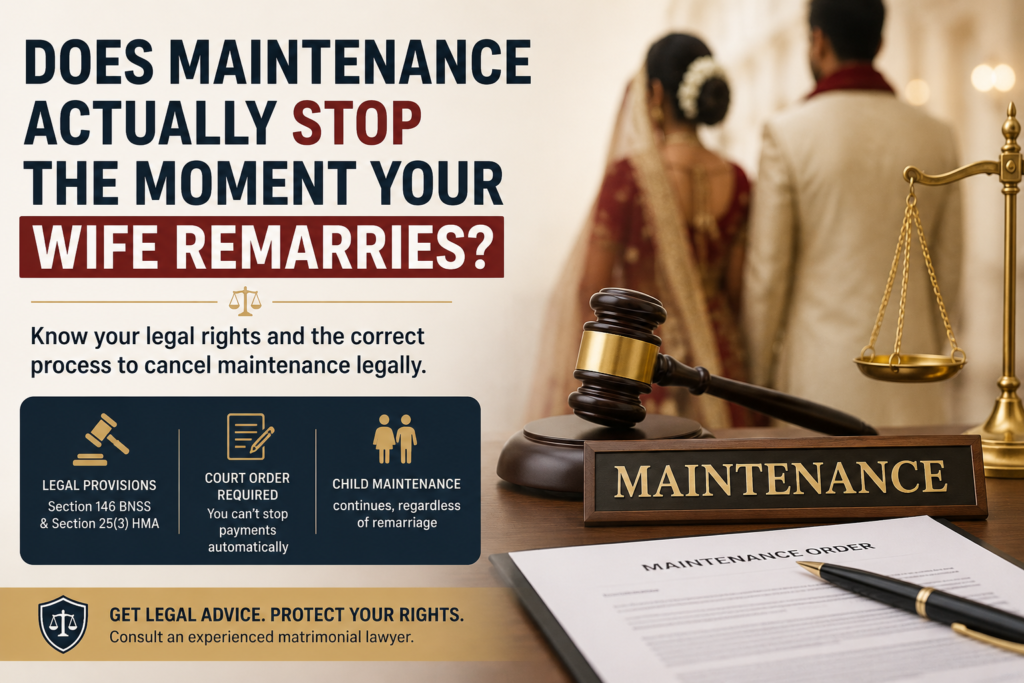
Know which law you are under. Arguments under Section 144 BNSS (formerly Section 125 CrPC), Section 24 of the Hindu Marriage Act, and the Domestic Violence Act operate in slightly different frameworks. The maintenance law under Section 144 BNSS is the broadest and most commonly invoked , and the one most relevant to the scenarios below.
Scenario 1: Wife Is Working and Still Claiming Maintenance
This is the cleanest scenario to argue , and often the most straightforward to win, if handled correctly.
The core argument:
Both parties are earning. Both are capable of maintaining themselves. The fundamental purpose of maintenance law , to prevent destitution , does not arise when the wife has her own independent income sufficient to meet her needs.
Put this before the court simply and directly: she earns, she spends, her income covers her expenditure, there is no shortfall requiring the husband’s contribution.
What to place on record:
Her salary slips, ITRs, Form 16, bank statements showing regular credits , everything that establishes her income. If she has not disclosed this honestly in her affidavit, this is where her credibility breaks down. Cross-reference every figure she has declared against documentary reality.
The legal position:
Courts have consistently held that where the wife is employed and earning a reasonable income, maintenance is either declined or substantially reduced. The object of maintenance is not to supplement the wife’s income indefinitely , it is to prevent genuine financial hardship.
Rely on the principle established across multiple High Court decisions: a working wife with stable employment is not entitled to maintenance merely because the husband earns more. Which brings us to Scenario 2.
Watch out for:
She may argue that her income is insufficient relative to the standard of living during the marriage. Address this by establishing that the standard of living she claims was not the actual standard maintained , use your own financial records and her bank statements to show what was actually spent during the marriage.
Scenario 2: Wife Is Earning Less Than the Husband
This is the most nuanced scenario and requires the most careful argumentation. Many husbands lose here not because the law is against them but because they fail to address the right points.
The fundamental legal principle , and it is crucial:
Maintenance law was never designed to equalise the incomes of husband and wife. It was designed to prevent destitution. These are two entirely different objectives.
The Supreme Court and multiple High Courts have repeatedly held that merely because the husband earns more does not automatically entitle the wife to maintenance, or to maintenance that bridges the income gap. The inquiry is whether she can maintain herself , not whether she can maintain herself at the husband’s income level.
Make this argument explicitly and anchor it to the judgments. Do not assume the court will apply it without you raising it.
The three-part argument for this scenario:
First , what are her actual expenditures?
Dig into her Income and Expenditure Affidavit. What has she declared as monthly expenditure? Is it supported by documents , rent receipts, utility bills, medical records, school fee receipts? In my experience, most expenditure sections of maintenance affidavits are inflated and poorly documented. Challenge every figure that lacks documentary support.
If her declared income covers her documented expenditure, the case for maintenance collapses regardless of what the husband earns.
Second , the husband’s liabilities are also higher.
A husband who earns more typically has correspondingly higher liabilities , home loan EMIs, car loan, dependant parents, insurance premiums, professional expenses, income tax outgo. These must all be on record in your affidavit. The court must see the net position, not just the gross salary figure.
This is where legal financial planning during the proceedings matters. Contributing to Voluntary Provident Fund (VPF) is a legitimate, documentable deduction from net take-home income. Paying genuine insurance premiums, servicing existing loans, and supporting dependant parents , all legitimate, all reducible to documents, all relevant to the net figure available for maintenance.
Third , the law of maintenance is not income equalisation.
State this plainly in your written submissions. Cite it. Judges are receptive to this argument when it is well-framed because it accurately reflects the legislative intent behind Section 144 BNSS and Section 25 of the Hindu Marriage Act.
Scenario 3: Wife Was Working but Stopped After Filing the Maintenance Petition
This scenario is extremely common , and extremely manageable if you move quickly and correctly.
What has happened:
The wife was employed before separation. She resigned , or claims to have been retrenched , shortly before or after filing the maintenance petition. She now appears before the court as unemployed and dependent.
The argument:
She did not lose her earning capacity. She abandoned it. Voluntarily.
Maintenance law does not reward voluntary idleness. Courts across India have held that where a wife is capable of earning and has chosen not to work, that capability is relevant to the maintenance assessment , and can result in either a denial or reduction of maintenance.
Put her prior employment on record. Her old salary slips, her LinkedIn profile, her EPF contribution history, her ITRs from prior years , all of this establishes what she was capable of earning and what she walked away from.
The counter-argument you will face , and how to handle it:
The wife’s lawyer will invariably cite judgments to the effect that “capable of working” and “actually working” are two different things , and that maintenance cannot be denied merely because the wife has the capacity to earn if she is not in fact currently earning.
This argument has merit and you must not dismiss it. Address it head-on.
Your response has two parts:
Part one: The voluntary nature of her unemployment distinguishes her case from one involving genuine inability to find work. A person who resigns from stable employment shortly before filing a maintenance petition is not in the same position as a person who has genuinely been unable to secure employment. Place the resignation date alongside the petition filing date on record and let the proximity speak for itself.
Part two: Seek a direction from the court. This is a practical remedy that courts are receptive to , particularly where the wife has clear employability. Submit before the court that the wife is qualified and capable of employment, and seek a direction that she make reasonable efforts to secure employment within a defined period , typically three months. During that period, the husband can be directed to pay a limited, time-bound maintenance amount.
This approach is reasonable, demonstrates good faith, and shifts the court’s focus from an indefinite maintenance obligation to a transitional arrangement. It also puts the wife under a judicial obligation to seek work , which changes the dynamics of the entire proceeding.
Scenario 4: Wife Is Working but Concealing Her Income
I have covered this in comprehensive detail in my earlier article , How to Prove Your Wife Is Earning in a Maintenance Case. The full toolkit is there: Income and Expenditure Affidavits, ITRs, bank statements, LinkedIn evidence, EPFO records, employer summons, interrogatories under Section 10 of the Family Courts Act, and private detective evidence for cash income.
The short version for this article: place documentary evidence of her employment on record before making the argument. An argument without evidence is an allegation. An argument backed by her own employer’s records, her bank statements, or her on-oath answers to interrogatories is a submission the court must respond to.
Scenario 5: Wife Was Never Employed and Has No Work History
This is the most delicate scenario , and the one where I see husbands make the most mistakes.
Let me be direct: if your wife genuinely has no education, no work experience, and no realistic prospect of employment, the “she should go work” argument will not carry much weight. Courts are realistic about employability. A 45-year-old woman who has spent 20 years as a homemaker and has a Class 10 education cannot simply be told to find a job. The court will not accept that argument, and pushing it aggressively will damage your credibility on the points that actually matter.
So what do you argue instead?
You argue on quantum , not on liability.
Accept, at least implicitly, that some maintenance may be payable. Your fight is not about whether maintenance is payable but about how much is reasonable and what it should actually cover.
Step one , attack the expenditure affidavit.
This is where cases in this scenario are actually won or lost. Go through her Income and Expenditure Affidavit line by line. For every expenditure item she has declared, ask: where is the document?
- Rent claim , where is the rent receipt or agreement?
- Medical expenses , where are the prescriptions, bills, doctor certificates?
- Transport costs , what is the basis for this figure?
- Food and household expenses , is this figure consistent with what was actually spent during the marriage?
In my experience, most wives in this scenario overstate their monthly expenditure significantly , and when pressed for documentation, cannot produce it. An expenditure figure that has no documentary support should be challenged specifically and in writing. Submit before the court that no documents have been produced to substantiate the expenditure declared, and that the court should not accept unverified figures as the basis for a maintenance order.
Step two , establish your legitimate deductions legally.
This is financial planning within the framework of the proceedings , and it is entirely legitimate.
If you are not already contributing to VPF (Voluntary Provident Fund), consider starting now. VPF contributions are deducted from your salary and reduce your net take-home. They are documentable, legal, and real. They do not disappear , they accumulate in your PF account , but for the purposes of the maintenance calculation, they reduce the figure available.
Similarly, genuine insurance premiums, home loan EMIs, support to dependant parents, and professional expenses all reduce the net figure. Every legitimate deduction must be documented and placed before the court in your affidavit.
Step three , define her actual needs, not her claimed needs.
What does she actually need to live reasonably? Go through the documented cost of rent in the area where she is living, documented food costs, documented medical needs. Build a counter-figure based on reality, not on what she has claimed.
Courts respond to this approach. A husband who walks in with a reasoned, documented alternative figure , rather than a bare denial , is taken more seriously than one who simply says “her expenses are too high.”
Practical Reality from Court Experience
Here is what I observe across all five scenarios:
Most maintenance cases are decided in the first few hearings. The interim maintenance order , which can take months to revisit , is typically passed on the basis of affidavits and documents available at the earliest stage. The husband who arrives unprepared at the first hearing, thinking it is just a procedural date, often walks out with an interim order that becomes very difficult to undo.
Judges are experienced at spotting both concealment and inflated claims. A wife who claims ₹80,000 in monthly expenditure but has no documentary support, and whose bank statements show no expenditure pattern consistent with that figure, will be noticed. Similarly, a husband who declares ₹40,000 income but drives a ₹15 lakh car and lives in a ₹3 crore flat will be noticed.
Written submissions matter more than oral arguments in maintenance cases. File your arguments in writing , state your case, cite your judgments, set out the figures. Oral submissions can be forgotten or misrecorded. A written note of arguments is on the record and cannot be disputed.
Settling maintenance well is often better than fighting indefinitely. A fair, documented, one-time settlement , arrived at with proper legal advice , ends the financial uncertainty completely. An ongoing monthly maintenance order is a recurring obligation that continues until circumstances change, and changing it requires another round of litigation. If settlement is possible on reasonable terms, evaluate it seriously.
Common Mistakes to Avoid
- Arriving at early hearings without a filed affidavit , interim maintenance can be ordered on the very first date
- Filing an incomplete or underestimated affidavit hoping the court will not notice
- Making bare arguments without supporting them with judgments or documents
- Failing to challenge specific figures in the wife’s expenditure affidavit in writing
- Arguing “she should work” without placing her prior employment and qualifications on record
- Not beginning legitimate financial planning , VPF, insurance, EMI documentation , early enough in the proceedings
- Missing the opportunity to seek interrogatories in Scenario 4
- Treating every scenario with the same generic argument , each situation requires a tailored approach
Frequently Asked Questions
Q1. Can maintenance be denied completely if the wife is working?
Yes. Where the wife is employed and earning an income sufficient to maintain herself, courts have declined maintenance entirely. The key is placing her income on record with documentary proof.
Q2. Is there a law that says maintenance is not meant to equalise incomes?
There is no single provision that states this in so many words , but it is a well-established judicial principle. Multiple High Courts and the Supreme Court have held that the purpose of maintenance is to prevent destitution, not to level the incomes of both spouses. Cite this principle specifically in your written submissions.
Q3. My wife resigned just before filing maintenance. Can I get maintenance stopped?
You can argue it, and courts are receptive when the voluntary nature of the resignation is established. Place the resignation date alongside the petition date on record. Also seek a direction for her to seek employment within a defined period.
Q4. What is VPF and how does it help in a maintenance case?
Voluntary Provident Fund contributions are additional contributions to your EPF account beyond the mandatory percentage. They are deducted from your salary, reduce your net take-home, are fully documented in your salary slip and Form 16, and are legally legitimate. Starting VPF contributions early in the proceedings reduces the net income figure the court uses as the basis for maintenance calculation.
Q5. My wife has no education or work history. Will the court still grant maintenance?
Very likely yes , some amount of maintenance will usually be granted in this scenario. Your focus should be on quantum, not liability. Attack her expenditure figures, document your own liabilities, and present a reasonable counter-figure based on documented reality.
Q6. How do I challenge her expenditure figures in court?
File a specific written objection to her Income and Expenditure Affidavit , item by item , noting which expenditure claims have no documentary support. Do not make a general objection; target each unsupported figure specifically.
Q7. Can I get interim maintenance reduced after it has been ordered?
Yes, through an application for modification supported by changed circumstances or new evidence of her income. It is harder than getting it right at the first hearing , which is why preparation before the first date matters so much.
Q8. What judgments should I cite in a maintenance case for the husband?
Key judgments include: Rajnesh v. Neha (2020) for financial disclosure framework; Chaturbhuj v. Sita Bai (2008) for the principle that a capable wife can be denied maintenance; Shamima Farooqui v. Shahid Khan (2015) for the factors courts consider in assessing maintenance. Your lawyer should identify the most current and applicable High Court judgments for your specific court.
Q9. Do I need to attend every maintenance hearing?
Yes. Non-appearance without cause can result in ex-parte orders. In maintenance cases especially, the early hearings are often the most consequential.
Q10. Should I settle or fight a maintenance case?
Depends on the amount being claimed, the strength of your position across the five scenarios above, and your personal priorities. A settlement that is documented properly and provides certainty is often better than years of litigation over monthly amounts.
Key Takeaways
- Tailor your argument to your specific scenario , generic denials do not work
- In Scenario 1 and 2, the principle that maintenance is not income equalisation is your anchor argument , put it in writing with judgments
- In Scenario 3, voluntary unemployment is argurable , but also seek a court direction for time-bound employment efforts rather than just denying liability
- In Scenario 4, evidence of employment must precede the argument , refer to the linked article for the full evidence toolkit
- In Scenario 5, fight on quantum not liability , attack the expenditure affidavit line by line and build legitimate deductions into your own affidavit
- File your Income and Expenditure Affidavit accurately, with all liabilities documented
- Written submissions and judgments on record outperform oral arguments every time
- The first hearing , and the interim maintenance order , often defines the entire case
Conclusion
There is no single argument that wins every maintenance case for a husband. What wins is understanding your scenario precisely, building your evidence before you walk into court, and making submissions that the judge can act on , not just assertions the other side can deny.
The five scenarios above cover the overwhelming majority of maintenance disputes I encounter in practice. Your situation will fit one of them , or a combination. Map your facts to the right scenario, build your affidavit and documentation accordingly, and make your arguments in writing.
Most importantly: do not wait for the second or third hearing to get serious. In maintenance cases, the first affidavit and the first hearing often determine everything that follows.
About the Author
Adv. Aman Chawla | Matrimonial Lawyer Divorce & Family Law Specialist
Legal Disclaimer
This article is intended solely for informational and educational purposes and does not constitute legal advice. The legal position may vary depending upon the facts of each case, amendments in law, and judicial interpretation. Readers should seek independent legal advice before acting on any information contained herein. Reading this article or communicating through the website does not create an advocate-client relationship.