Author: Advocate Aman Chawla, The Matrimonial Lawyers | Divorce Law, Matrimonial Remedies, Supreme Court
Your spouse has left. They have moved out, stopped responding, and are refusing to come home.
Can you go to court and legally compel them to return?
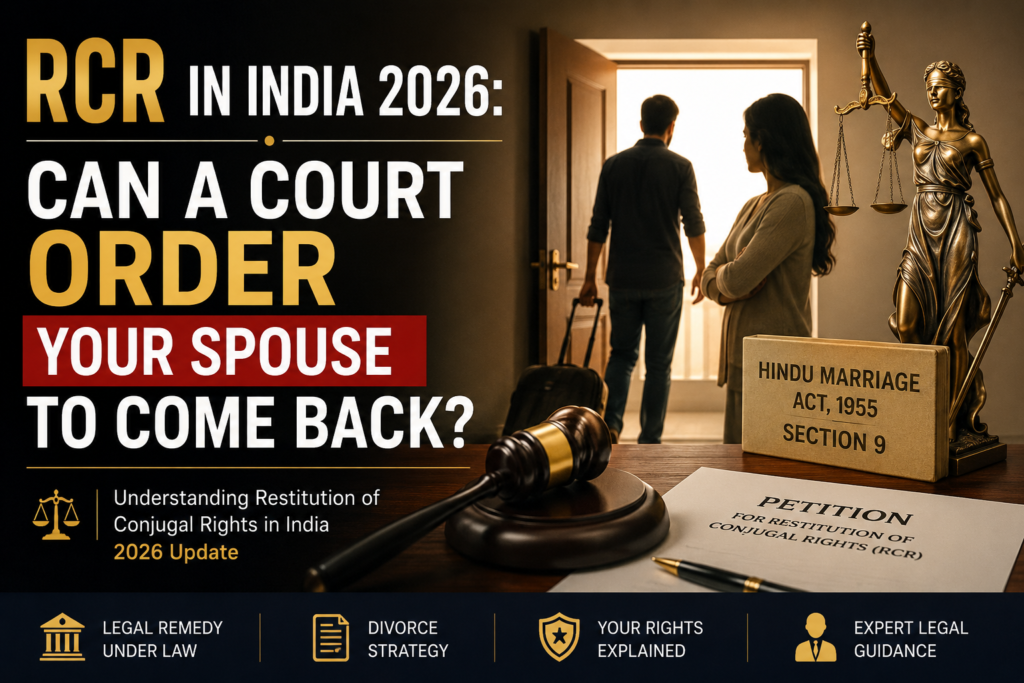
In India, the answer — surprisingly — is yes. There is a legal remedy called Restitution of Conjugal Rights (RCR) that allows one spouse to petition a court to order the other to resume marital life. It has existed in Indian law for over a century.
But in 2026, this remedy is under the most serious legal challenge it has ever faced. A constitutional petition is pending before the Supreme Court questioning whether RCR is even legal. Courts are increasingly cautious about how they use it. And for many people going through a matrimonial dispute in Delhi, it is either a powerful strategic tool — or a threat they urgently need to understand.
This guide explains exactly what RCR is, what it actually does (and what it does not), how courts in Delhi use it in 2026, and what the pending Supreme Court challenge means for your case.
What Is Restitution of Conjugal Rights?
Restitution of Conjugal Rights is a remedy under Section 9 of the Hindu Marriage Act, 1955 (and Section 22 of the Special Marriage Act, 1954). It allows a spouse who has been left — without reasonable excuse — to approach the district court and seek an order that the other spouse return to the matrimonial home.
The provision reads simply: if either spouse has “withdrawn from the society of the other without reasonable excuse,” the aggrieved party may apply to the district court for restitution of conjugal rights. If the court is satisfied that the withdrawal is without justification, it may pass a decree directing the respondent spouse to resume cohabitation.
In theory, it is a mechanism for reconciliation. In practice, it is far more complicated.
What RCR Actually Does — And Does Not Do
This is the most important thing to understand: a court cannot physically force a spouse to return home.
No police officer will escort your husband or wife back to the matrimonial house. No court officer will supervise cohabitation. The court’s decree is not enforceable in the sense of compelling bodily presence.
What enforcement does exist is limited to attachment of property under the Code of Civil Procedure in exceptional circumstances — a mechanism that is rarely used and widely criticised.
So what does an RCR decree actually achieve? In practice, three things:
1. It creates a legal record of “desertion without cause.” If the respondent refuses to comply with an RCR decree for one year or more, the petitioner becomes entitled to file for divorce on the ground of non-compliance. This converts RCR into a pathway to contested divorce — faster than the conventional desertion timeline.
2. It affects maintenance claims. A court may reduce or deny maintenance to a spouse who has withdrawn without reasonable cause and refused to comply with an RCR decree.
3. It shapes the narrative in ongoing litigation. An RCR decree on record influences how judges view the parties’ respective conduct — which matters in contested cases involving cruelty, desertion, or financial disputes.
The Pending Supreme Court Challenge: Is RCR Unconstitutional?
This is where 2026 becomes critically important for anyone dealing with an RCR case.
A constitutional petition filed by students of Gujarat National Law University (GNLU) — Ojaswa Pathak & Anr. v. Union of India (WP(C) 250/2019) — is currently pending before the Supreme Court. The petition challenges the constitutional validity of Section 9 of the Hindu Marriage Act and Section 22 of the Special Marriage Act.
The petitioners argue:
- RCR violates Article 21 (right to life and personal liberty), including the right to privacy and bodily autonomy affirmed by the Supreme Court in Justice K.S. Puttaswamy v. Union of India (2017)
- RCR places an unequal burden on women, violating Article 14 (right to equality) — because despite being gender-neutral on paper, its practical effect overwhelmingly falls on wives
- The provision has feudal origins in 19th-century English law, where wives were considered property — making it incompatible with the Constitution’s vision of marriage and dignity
- It has been misused in matrimonial litigation to defeat women’s maintenance claims and coerce compliance
The Union Government’s position: The Centre has defended RCR before the Supreme Court, calling it a “practical matrimonial remedy” that encourages reconciliation rather than rushed divorce.
Current status in 2026: The challenge remains pending. The Supreme Court has not yet delivered its verdict. Until it does, Section 9 of the HMA and RCR remain valid law — but courts are increasingly sensitive to constitutional arguments in individual RCR cases. Several High Courts have expressed reservations about granting decrees mechanically, particularly where the petitioning spouse has a history of violence or cruelty.
The outcome of this challenge — when it comes — will reshape matrimonial litigation across India. Anyone with an RCR case pending right now is operating in genuinely uncertain legal terrain.
How RCR Is Used as a Divorce Strategy in Delhi
In Delhi’s family courts, RCR petitions are often filed not because a spouse genuinely wants reconciliation, but as deliberate litigation strategy. Understanding this is essential — whether you are filing one or defending against one.
RCR as a Divorce Shortcut
The Hindu Marriage Act requires a waiting period of at least one year of desertion before filing for divorce on desertion grounds. But if one spouse files for RCR and the other refuses to comply for one year, the petitioner can immediately file for divorce under Section 13(1A)(ii) of the HMA — on the ground that the RCR decree has not been complied with for one year.
This is sometimes faster and strategically cleaner than litigating through contested divorce directly.
RCR to Counter Maintenance Claims
A spouse who has left without reasonable cause and refuses to return despite an RCR decree is in a weaker position in maintenance proceedings. Courts are less sympathetic to maintenance applications from a spouse whose departure was unjustified.
RCR as Pressure
An RCR petition creates immediate legal pressure on the respondent spouse. It forces them to either return, comply, or mount a legal defence — raising their own litigation costs and time.
Defending Against an RCR Petition
If your spouse has filed an RCR petition against you, you are not without options. The single most important word in Section 9 is “reasonable excuse.”
If you withdrew from the matrimonial home because of:
- Cruelty (physical or mental)
- Domestic violence
- Sexual abuse
- Threats or intimidation
- Genuinely irretrievable breakdown
then you have a reasonable excuse, and the court must dismiss the RCR petition.
A skilled matrimonial lawyer will build your defence around the documented history of the marriage — WhatsApp messages, medical records, police complaints, witness statements — to demonstrate that your withdrawal was fully justified. A strong RCR defence also sets the narrative for any parallel divorce or DV proceedings.
The Intersection With Domestic Violence Proceedings
One of the most dangerous misuses of RCR is against women who have left home due to domestic violence. A husband filing RCR while a domestic violence case is pending essentially asks the court to order the victim back to the abuser’s home.
Courts have increasingly refused to grant RCR decrees in such circumstances. Where a protection order under the Domestic Violence Act is in force, an RCR petition from the protected person’s abuser will typically fail.
If you have left home due to domestic violence and face an RCR petition, the two proceedings must be handled together — with your DV case forming the central plank of your RCR defence.
What Delhi Family Courts Look at in RCR Cases in 2026
When an RCR petition comes before a Delhi family court today, the judge will typically assess:
- Was there a valid marriage? (jurisdictional threshold)
- Did the respondent actually withdraw from the petitioner’s company?
- Was that withdrawal without reasonable excuse?
- Is reconciliation genuinely possible? Many courts in 2026 send parties to mediation before proceeding with an RCR petition
- Are there parallel proceedings — DV, 498A, maintenance — that affect the picture?
- What is the overall conduct of the parties?
Courts are slower and more careful than they were a decade ago. The constitutional challenge to RCR, combined with evolving judicial sensitivity about coercion in marriage, has made Delhi judges more willing to dismiss RCR petitions where the factual foundation is weak.
Practical Advice: Should You File — or Fight — an RCR Petition?
If you are considering filing an RCR petition:
Be clear-eyed about what it will achieve. If your genuine goal is reconciliation, mediation is usually faster and more effective. If your goal is a clean divorce pathway, or to establish a legal record that affects maintenance, RCR may be a legitimate strategy — but only if your factual position is strong. Discuss the strategy in detail with your matrimonial lawyer before filing.
If your spouse has filed an RCR against you:
Do not ignore it. An uncontested RCR decree creates legal consequences that can be very difficult to unpick later — particularly in divorce and maintenance proceedings. File a properly pleaded defence, document every reason for your withdrawal, and if domestic violence is involved, ensure your DV proceedings are filed and active.
Either way, specialist legal advice from the outset is not optional — it is essential.
The Matrimonial Lawyers Can Help
Advocate Aman Chawla has filed and defended RCR petitions across Delhi’s family courts, the Delhi High Court, and in cases where RCR intersects with DV proceedings, 498A, and transfer petitions. Every RCR case is handled with a clear-eyed litigation strategy tailored to what you actually need — not just what the law technically allows.
Free first consultation. Completely confidential. No obligation.
📞 Call / WhatsApp: +91-8076836899 📧 Email: info@thematrimoniallawyers.com 📍 O-11A Basement, Jangpura Extension, New Delhi – 110014
Available Monday–Saturday, 9am–7pm. WhatsApp after hours.
FAQ
Q1: What is Restitution of Conjugal Rights (RCR) under Indian law?
RCR is a legal remedy under Section 9 of the Hindu Marriage Act, 1955, allowing one spouse to apply to the district court for an order directing the other spouse to return to the matrimonial home, when the other has withdrawn from their company without reasonable excuse. Despite its name, courts cannot physically force a spouse to return. Its practical significance lies in its impact on divorce strategy and maintenance proceedings.
Q2: Can an Indian court actually force my husband or wife to come home?
No. An RCR decree does not give any court the power to physically compel a spouse to return. Enforcement is limited to property attachment under the CPC in rare circumstances, and even that is seldom exercised. What a decree does is create legal consequences — particularly the right to file for divorce after one year of non-compliance, and a potential impact on maintenance claims.
Q3: Is RCR still legal in India in 2026?
Yes. Section 9 of the Hindu Marriage Act remains valid law in 2026. However, a constitutional challenge — Ojaswa Pathak v. Union of India — is currently pending before the Supreme Court, arguing that RCR violates fundamental rights to privacy, dignity, and equality. Until the Supreme Court decides, courts continue to apply Section 9, but with increasing caution, particularly in cases involving domestic violence.
Q4: How can I defend against an RCR petition filed by my spouse?
The key defence is “reasonable excuse.” If you left the matrimonial home due to cruelty, domestic violence, mental abuse, or any other justified cause, the court must dismiss the RCR petition. A properly filed defence, supported by documented evidence of your reasons for leaving, is essential. Never ignore an RCR petition — an undefended decree has lasting legal consequences.
Q5: How is RCR used as a divorce strategy in India?
If one spouse files an RCR petition and the other refuses to comply for one year after a decree is passed, the petitioner can file for divorce under Section 13(1A)(ii) of the HMA without needing to prove full-length desertion. This makes RCR a faster strategic pathway to divorce in some cases. It can also be used to weaken the respondent’s maintenance claim by establishing unjustified departure from the marriage.
Q6: Can RCR be filed against a spouse who has a domestic violence case pending?
RCR can technically be filed regardless of parallel proceedings, but courts will not ordinarily grant a decree that orders a domestic violence victim to return to the alleged abuser’s home. Where a protection order under the PWDV Act 2005 is in force, an RCR decree from the same person is extremely unlikely to succeed. If you face this situation, your DV and RCR proceedings must be handled together as an integrated legal strategy.
Q7: What happens if my spouse does not comply with an RCR decree?
If the respondent spouse does not comply with an RCR decree for a period of one year or more, the petitioner acquires the right to file for divorce under Section 13(1A)(ii) of the Hindu Marriage Act. Non-compliance can also affect the respondent’s maintenance claims and shapes the overall narrative of fault in the divorce proceedings.
Q8: Does RCR apply to all religious communities in India?
Section 9 of the HMA applies to Hindus, Buddhists, Jains, and Sikhs. Section 22 of the Special Marriage Act provides the same remedy for couples married under that Act. Separate provisions exist under the Indian Divorce Act for Christians and under personal laws for other communities. The constitutional challenge before the Supreme Court targets both the HMA and SMA provisions.
Q9: My spouse filed RCR against me from another city. Can the case be transferred to Delhi?
Yes. A transfer petition can be filed before the Supreme Court or the High Court to transfer the RCR case to a court in Delhi — particularly where attending hearings in the original court creates genuine hardship, safety concerns, or logistical difficulty. The Matrimonial Lawyers handles transfer petitions routinely as part of integrated matrimonial strategies.
Consult Adv. Aman Chawla, Matrimonial Law Specialist, practicing before the Supreme Court of India, Delhi High Court, and all Delhi District Courts. Available for urgent matters, outstation clients, and online consultations across India.
Call: +91-8076836899 | WhatsApp | Email: info@thematrimoniallawyers.com Office: O-11A Basement, Jangpura Extension, New Delhi – 110014
Written by Adv. Aman Chawla. This article is for informational purposes only and does not constitute legal advice. Every case is fact-specific. Please consult a qualified lawyer before taking any legal action.