By Advocate Aman Chawla | The Matrimonial Lawyers, New Delhi Published: June 2026
Most people asking this question already know what they’ve been told.
Only the wife can claim maintenance.” “A man cannot ask for alimony in India.” “You’re the husband — you’re expected to pay, not receive.”
Every one of these statements is legally incorrect.
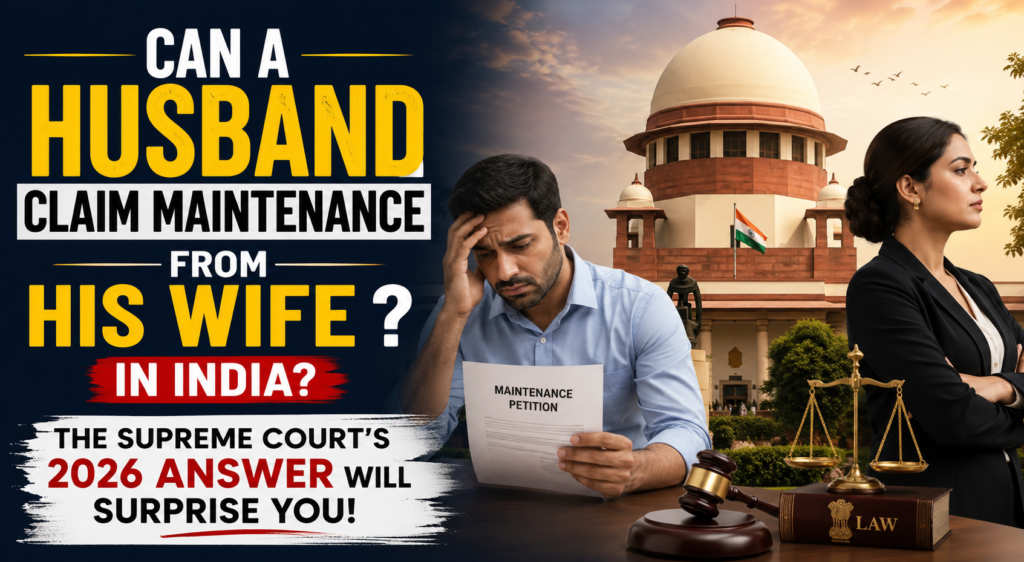
Can a husband claim maintenance from his wife in India? Yes — under specific provisions of Indian matrimonial law. And in 2026, the Supreme Court has clarified exactly when, how much, and under what circumstances a husband’s claim for maintenance will succeed.
This guide explains it clearly — the law, the 2026 rulings, the practical reality in Delhi’s family courts, and what you need to know before you file or defend a maintenance application.
The Law: Which Provisions Allow a Husband to Claim Maintenance?
Indian matrimonial law is not as gender-exclusive as popular belief suggests. Two key provisions expressly allow a husband to seek maintenance from his wife.
Section 24 of the Hindu Marriage Act, 1955 — Pendente Lite Maintenance
This is the most important provision for husbands. Section 24 HMA provides that either spouse — not just the wife — may apply to the court for interim maintenance and litigation expenses during the pendency of matrimonial proceedings.
The provision uses the word “either party.” It is gender-neutral on its face. A husband who has no independent income, or whose income is substantially lower than his wife’s, can apply under Section 24 for maintenance during divorce, restitution of conjugal rights, judicial separation, or other matrimonial proceedings.
Section 25 of the Hindu Marriage Act, 1955 — Permanent Alimony
Section 25 allows the court to order permanent alimony or maintenance at the time of any decree under the HMA — or at any point thereafter. Again, either spouse may apply. A husband who is physically or financially unable to support himself after divorce may seek permanent alimony from a working, earning wife.
What About Section 125 CrPC / Section 144 BNSS?
This is where the law is more restrictive. Under Section 125 of the old Criminal Procedure Code — and its equivalent Section 144 of the Bharatiya Nagarik Suraksha Sanhita (BNSS), which governs new matters — maintenance can be claimed by a wife, children, and parents. A husband cannot claim maintenance from his wife under this provision.
So in summary: a husband CAN claim maintenance under the Hindu Marriage Act (Sections 24 and 25). He CANNOT claim it under Section 144 BNSS / 125 CrPC.
What the Supreme Court Said in 2026
The Supreme Court has issued several rulings in 2025 and 2026 that directly shape how maintenance claims — from both sides — are handled in practice.
The “wealth equalisation” bar: The Supreme Court has ruled clearly that a divorced wife cannot seek permanent alimony merely to achieve equal wealth status with her ex-husband. The Court established that while a spouse is entitled to maintain their matrimonial standard of living as far as possible, the other party cannot be perpetually obligated to fund an ever-rising lifestyle claim tied to post-divorce success. The same principle applies when a husband seeks maintenance: the court will assess whether there is a genuine need — not whether the wife has accumulated assets.
The “working spouse” rule: The Supreme Court confirmed that the fact that a spouse is educated or employed does not automatically end the other party’s maintenance claim — but it is a central factor. Courts examine: Is the income sufficient? Does the other party have genuine need? What was the standard of living during the marriage?
The husband’s claim — judicial attitude: Delhi High Court and Supreme Court decisions in 2025–2026 show that while husband-side maintenance claims remain uncommon, courts approach them without gender bias where the factual need is clear. A husband who is genuinely dependent — through unemployment, illness, or earning a significantly lower income than his wife — has a legitimate legal claim.
When Can a Husband Successfully Claim Maintenance from His Wife?
The practical threshold for a successful Section 24 or Section 25 claim by a husband requires demonstrating one or more of the following:
1. No independent income or insufficient income The most straightforward scenario. If the husband is unemployed, has no business income, or earns substantially less than the wife, a court will assess whether maintenance is necessary to allow him to sustain himself and participate fairly in the litigation.
2. Physical incapacity or serious illness Where the husband is unable to work due to disability, chronic illness, or medical condition — and the wife has substantial income — courts have granted maintenance to ensure basic financial dignity.
3. Significant income disparity Even where the husband works, a Section 24 application can succeed if there is a dramatic disparity in income — particularly where the husband cannot meet reasonable litigation costs. Courts have ordered wives to pay the husband’s litigation expenses in such cases even when they have not ordered full maintenance.
4. Pendency of matrimonial proceedings Section 24 maintenance is specifically designed for the duration of matrimonial proceedings. If a contested divorce, restitution of conjugal rights, or judicial separation is pending, and the husband cannot fund the litigation on an equal footing, he may apply for temporary maintenance specifically to level the playing field.
Why Husbands Almost Never Apply — And Why That Is Changing
The reality in Delhi’s family courts is that husband-side maintenance applications are uncommon. The reasons are social, not legal:
- Social stigma: men are culturally expected to support, not claim support
- Fear that the application signals weakness in the overall matrimonial case
- Lack of awareness that the legal right even exists
- Tactical hesitation — filing a maintenance claim as a husband while simultaneously defending the marriage can appear contradictory
But this is changing rapidly in 2026 — particularly in dual-income urban marriages where wives earn significantly more, or where the husband left a career for family responsibilities, or where the wife’s business income substantially exceeds the husband’s professional income.
Delhi High Court judges have recently signalled that Section 24 applications from husbands will be assessed on exactly the same factual basis as applications from wives. The gender-neutral language of the provision is being taken seriously.
Can a Wife Refuse to Pay Maintenance to Her Husband?
A wife who has received a maintenance order from the family court — or an interim order under Section 24 — cannot simply refuse to comply. Failure to pay court-ordered maintenance is enforceable through:
- Attachment of salary or bank accounts
- Contempt of court proceedings
- Execution proceedings through the family court
At the same time, a wife who believes the order is wrong can apply to vary or set aside the maintenance amount — particularly if she can demonstrate that the husband’s claimed financial hardship is exaggerated, that he has concealed income, or that his situation has changed after the order was made.
The burden of evidence is central. In maintenance cases, both sides are expected to produce income affidavits, tax returns, salary slips, and business accounts. Where either party conceals their true financial position, courts have shown an increasing willingness to draw adverse inferences.
The Working Wife and Maintenance: A Specific Scenario
Many husbands ask: “My wife earns more than I do. Can I claim maintenance?”
The answer is: it depends — but the law allows it.
If your wife is earning substantially more than you during the pendency of divorce or other matrimonial proceedings, and you genuinely need financial support to sustain yourself and fund the litigation, Section 24 HMA gives you the right to apply. Courts will examine:
- Comparative income of both parties (salary slips, IT returns, bank statements)
- Standard of living during the marriage
- Whether you are capable of earning more (courts will not reward deliberate idleness)
- Expenses of children, if any, and who bears them
- Duration of the marriage and financial interdependence during it
The Supreme Court’s 2025–2026 rulings make clear that maintenance — whoever claims it — must reflect genuine need and the marital standard of living. It is not a windfall. But it is also not restricted by gender.
Maintenance and 498A, Domestic Violence Cases: The Overlap
In Delhi matrimonial practice, maintenance cases rarely travel alone. They intersect with:
498A / Section 85 BNS cases: Where a wife has filed a 498A complaint against the husband simultaneously with maintenance proceedings, the husband’s maintenance application does not reduce his rights to defend the criminal case. However, courts will be alert to inconsistencies — a husband claiming poverty for maintenance purposes while also claiming financial losses in the criminal case should be careful about the positions he takes across proceedings.
Domestic Violence cases: Under the Domestic Violence Act 2005, monetary relief — including maintenance — can be awarded only to the aggrieved wife. A husband has no equivalent right under that Act. His maintenance rights exist exclusively under the HMA.
Transfer Petitions: Where maintenance proceedings are filed in a distant court and the husband needs them transferred to Delhi — or vice versa — a Transfer Petition before the Supreme Court is available. Maintenance orders from one court can also be enforced in another state through execution proceedings.
Practical Steps If You Want to Claim Maintenance as a Husband
If you believe you have a legitimate claim for maintenance from your wife, here is what Advocate Aman Chawla recommends before filing:
- Assess your financial position honestly. Courts will scrutinise income affidavits carefully. Do not overstate your hardship or conceal any income. Credibility before the court is your most valuable asset.
- Document your wife’s income comprehensively. Salary slips, LinkedIn profile showing designation, business registration, bank statements — all of this builds the income disparity case.
- Establish the marital standard of living. Evidence of joint expenses, lifestyle during the marriage, shared accounts — courts use this to calibrate what maintenance should replicate.
- Assess the timing strategically. A Section 24 application is most powerful when filed at the outset of matrimonial proceedings — before the wife has established a one-sided financial narrative in court.
- Get specialist legal advice before filing. Maintenance cases involving husband applicants require careful framing. Courts are receptive — but the application must be credibly and precisely presented.
How The Matrimonial Lawyers Can Help
Advocate Aman Chawla has represented both husbands and wives in maintenance proceedings across Delhi’s family courts — Saket, Tis Hazari, Rohini, Karkardooma, Dwarka — the Delhi High Court, and the Supreme Court of India.
Whether you are a husband seeking to file a maintenance application, a wife defending against one, or either party dealing with maintenance alongside a larger contested divorce — we provide a written legal strategy within 3 to 5 working days of your first consultation.
First consultation: completely Online, 100% confidential, no obligation.
📞 Call / WhatsApp : +91-8076836899 📧 Email : info@thematrimoniallawyers.com 📍 Office : O-11A Basement, Jangpura Extension, New Delhi – 110014 ⏰ Hours : Monday–Saturday, 9am–7pm WhatsApp available after hours
FAQ
Q1: Can a husband legally claim maintenance from his wife in India?
A: Yes. Section 24 of the Hindu Marriage Act, 1955 expressly allows either spouse — including the husband — to apply for interim maintenance and litigation expenses during matrimonial proceedings. Section 25 HMA further allows either party to seek permanent alimony after a decree. The law is gender-neutral in this respect. However, Section 144 BNSS (formerly Section 125 CrPC) does not extend maintenance rights to husbands — that provision covers only wives, children, and parents.
Q2: Under which provision can a husband claim maintenance from his wife?
A: The primary provision is Section 24 of the Hindu Marriage Act, 1955, which allows either party — husband or wife — to apply for interim maintenance and litigation costs during pending matrimonial proceedings. Section 25 HMA covers permanent alimony and is also gender-neutral. These are the husband’s only maintenance avenues; Section 144 BNSS and the Domestic Violence Act 2005 do not provide maintenance rights to husbands.
Q3: What must a husband prove to get maintenance from his wife?
A: A husband applying for maintenance under Section 24 HMA must demonstrate: (a) that matrimonial proceedings are pending; (b) that he has no independent income or his income is insufficient to support himself and fund the litigation; and (c) that the wife has the means to pay. Courts also look at the standard of living during the marriage and any income disparity between the parties. Deliberately abandoning income to manufacture hardship is viewed adversely.
Q4: My wife earns more than me. Can I get maintenance during our divorce?
A: Possibly yes. If your wife’s income substantially exceeds yours and you genuinely need financial support during pending divorce proceedings, a Section 24 HMA application is available to you. Courts in Delhi assess the comparative income of both parties, the marital standard of living, and the genuine need of the applicant. A well-presented application with clear income documentation from both sides gives you the strongest chance of success.
Q5: Does the Supreme Court allow husbands to claim maintenance in 2026?
A: Yes. The Supreme Court has confirmed that Section 24 HMA is gender-neutral and applies to both spouses. In 2026, the Court has also clarified that maintenance — whoever claims it — must be based on genuine need and the marital standard of living, not on wealth equalisation. Courts approach husband-side applications on the same factual criteria as wife-side applications.
Q6: Can a wife refuse to pay maintenance ordered by a Delhi family court?
A: No. Court-ordered maintenance — including interim maintenance under Section 24 HMA — is legally enforceable. A wife who refuses to comply can face salary attachment, bank account attachment, contempt of court proceedings, and execution before the family court. She can, however, apply to vary the order if her financial circumstances change or if she believes the amount is disproportionate.
Q7: Can a husband claim maintenance even if the wife doesn’t earn a salary?
A: If the wife has no income or insufficient means, a maintenance application by the husband is unlikely to succeed. Courts require the respondent to have the financial capacity to pay. However, where a wife has business income, rental income, inherited property, or significant assets — even without a formal salary — courts have granted maintenance applications by husbands. All sources of income and assets are assessed, not just salary.
Q8: My wife filed a 498A case against me. Can I still claim maintenance?
A: Yes. A pending 498A or Section 85 BNS case does not bar you from filing a Section 24 maintenance application in the civil matrimonial proceedings. The two run on separate tracks — civil and criminal. However, you must be careful about consistency: the financial position you assert in the maintenance application should not contradict your position in the criminal proceedings. Your lawyer should coordinate both cases as a single integrated strategy.
Q9: What is the difference between interim maintenance and permanent alimony for a husband?
A: Interim maintenance under Section 24 HMA is paid during the pendency of matrimonial proceedings — it ends when the case is decided. Permanent alimony under Section 25 HMA is ordered at or after the final decree — and can be a lump sum payment or monthly amount. Both are available to husbands, not only wives. Permanent alimony for a husband is rarer in practice but is available where genuine long-term financial need is established.
Q10: How long does a husband’s maintenance case take in Delhi?
A: Section 24 interim maintenance applications in Delhi family courts typically take 3 to 12 months from filing to order, depending on the court, the complexity of income evidence, and whether the wife contests the application. Courts can grant interim-on-interim orders within weeks in urgent cases. Section 25 permanent alimony is decided as part of the final decree, which can take considerably longer depending on the overall divorce timeline. Advocate Aman Chawla provides realistic timelines during the initial consultation — call +91-8076836899.
Consult Adv. Aman Chawla, Matrimonial Law Specialist, practicing before the Supreme Court of India, Delhi High Court, and all Delhi District Courts. Available for urgent matters, outstation clients, and online consultations across India.
Call: +91-8076836899 | WhatsApp | Email: info@thematrimoniallawyers.com Office: O-11A Basement, Jangpura Extension, New Delhi – 110014
Written by Adv. Aman Chawla. This article is for informational purposes only and does not constitute legal advice. Every case is fact-specific. Please consult a qualified lawyer before taking any legal action.