Introduction
You have just been served a maintenance notice. Or perhaps you are the one filing for maintenance. Either way, somewhere in the early stages of the proceeding, the court will ask both of you to file something called an Income and Expenditure Affidavit.
Most people either take it too lightly — filling it in carelessly — or take it too seriously in the wrong direction — attempting to hide assets or understate income. Both approaches are mistakes, and both carry real consequences.
This article explains exactly what an Income and Expenditure Affidavit is, why the Supreme Court made it mandatory, what it must contain, and — most importantly — how it actually affects the outcome of a maintenance case.
Quick Answer
An Income and Expenditure Affidavit is a sworn statement filed by both parties in a maintenance proceeding, disclosing their complete financial position — income, assets, liabilities, and monthly expenditure. It was made mandatory by the Supreme Court in Rajnesh v. Neha (2020) to ensure that maintenance orders are based on the actual financial reality of both spouses, not just what each side claims in their pleadings. Filing a false affidavit is perjury. Concealing assets or income can result in adverse inferences being drawn by the court — and can significantly affect the maintenance amount awarded.
Why Did the Supreme Court Make It Mandatory?
Before Rajnesh v. Neha (2020), maintenance proceedings in India were often decided on the basis of vague, unverified claims. Husbands would understate their income. Wives would overstate their needs or conceal their earnings. Courts had limited tools to get to the truth.
The Supreme Court, in Rajnesh v. Neha, addressed this problem directly. The court held that in all maintenance proceedings — whether under Section 144 BNSS (formerly Section 125 CrPC), the Hindu Marriage Act, or the Domestic Violence Act — both parties must file a detailed affidavit of their income, assets, and expenditure at the very first hearing.
The objective was simple: base maintenance decisions on financial reality, not financial theatre.
The affidavit is now a standard, non-negotiable requirement in every maintenance proceeding across India.
What Does the Affidavit Contain?
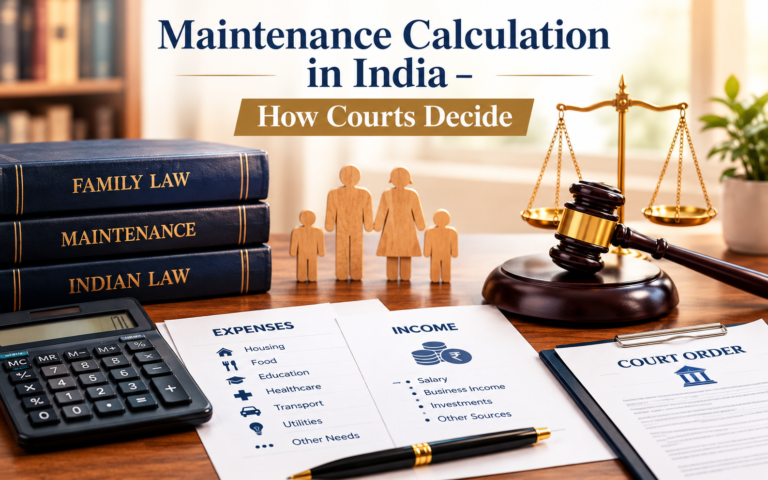
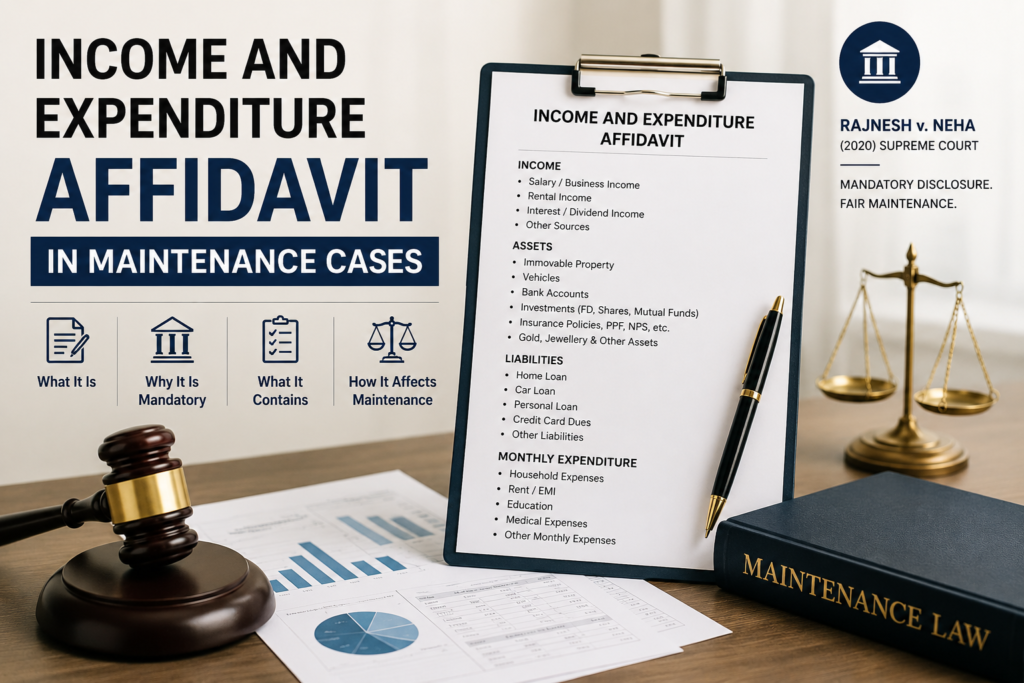
The Income and Expenditure Affidavit is comprehensive. It is not a one-page document. A properly filed affidavit covers the following:
Income:
- Monthly salary with salary slips and Form 16
- Business or professional income with supporting accounts
- Rental income from any property
- Agricultural income
- Interest income from fixed deposits, savings accounts
- Dividend income from shares or mutual funds
- Any other regular or irregular receipts
Assets:
- Immovable property — residential, commercial, agricultural
- Vehicles
- Bank accounts — savings, current, joint
- Fixed deposits and recurring deposits
- Mutual fund investments with current value
- Equity shares and demat account holdings
- PPF, NPS, and other retirement accounts
- Gold and jewellery
- Insurance policies with surrender value
- Any other investment or asset of value
Liabilities:
- Outstanding home loans
- Car loans
- Personal loans
- Credit card outstanding dues
- Any other financial obligation
Monthly Expenditure:
- Household expenses
- Rent or EMI
- Children’s school fees and related expenses
- Medical expenses
- Transportation
- Any other regular monthly outgoing
Supporting Documents to be Filed Alongside:
- Income Tax Returns for the last three years
- Salary slips for the last six months
- Form 16
- Bank statements for the last six to twelve months
- Demat account statements
- Property documents
- Any other relevant financial record
How Does It Actually Affect the Maintenance Amount?
This is the question that matters most, and the answer is direct: the affidavit is the single most important document in a maintenance proceeding.
Here is why.
Maintenance is not calculated by a formula. Courts assess the financial position of both parties and arrive at a figure that is fair given the circumstances of the marriage, the standard of living enjoyed, the needs of the claiming party, and the paying party’s actual capacity.
The affidavit provides the raw material for that assessment. A detailed, honest affidavit that accurately reflects income and assets gives the court what it needs to arrive at a fair figure. A carelessly or dishonestly filed affidavit creates problems — for both sides.
For the husband: If the affidavit understates income and the wife subsequently produces contradicting evidence — bank statements, ITRs, employer records — the court draws an adverse inference. Judges are experienced enough to recognise deliberate concealment, and they penalise it, usually by assuming the actual income is higher than disclosed.
For the wife: If the affidavit claims unemployment or understates assets and the husband subsequently produces her LinkedIn profile, EPFO records, or bank statements showing regular salary credits, her credibility takes serious damage — not just on maintenance, but across the entire proceeding.
Practical Reality from Court Experience
Here is what I observe in maintenance proceedings involving the affidavit:
Most affidavits filed in the early stages of proceedings are incomplete. Parties — and sometimes their lawyers — treat the first affidavit as a placeholder. The court typically allows parties to file revised or supplemented affidavits. But the first affidavit sets the tone. A dramatically different second affidavit invites uncomfortable questions.
Cash income is the most commonly concealed item. Business owners, traders, self-employed professionals, and individuals earning from tuitions, rent collected in cash, or informal income streams frequently understate this component. Courts are aware of this tendency and look at lifestyle, assets, and expenditure patterns to test whether declared income is consistent with how the person actually lives.
The expenditure section is often treated carelessly — and it should not be. A wife claiming high monthly needs must support those needs with figures that are consistent with the family’s actual standard of living during the marriage. Inflated expenditure claims that bear no relationship to the marriage’s financial reality are challenged effectively by a husband who has kept his own financial records.
Judges read these affidavits carefully. This is not paperwork that gets filed and forgotten. In experienced matrimonial courts, judges cross-reference the affidavit figures against the bank statements and ITRs filed alongside. Discrepancies are noticed.
Filing a false affidavit has real consequences. Beyond adverse inferences on maintenance, a deliberately false affidavit filed before a court is perjury under Indian law. While prosecutions are not common, the threat is real — and more importantly, a false affidavit, once exposed, effectively ends a party’s credibility in the proceeding.
What Happens If a Party Refuses to File or Files an Incomplete Affidavit?
Courts take non-compliance seriously. Where a party fails to file the affidavit as directed, or files one that is clearly incomplete, the court may:
- Draw adverse inferences against the non-complying party
- Proceed to decide maintenance on the basis of available material
- Impose costs on the defaulting party
- In appropriate cases, take coercive steps to compel compliance
The Supreme Court in Rajnesh v. Neha was clear that the filing of the affidavit is not optional. Courts that are serious about the direction do not allow parties to simply ignore it.
Practical Tips — If You Are the Husband
- File a complete, accurate affidavit. Understatement of income that is subsequently exposed damages your case far more than the actual income figure would have.
- If your wife’s affidavit is incomplete or inconsistent, challenge it immediately — file an application pointing out specific discrepancies and seek directions for complete disclosure.
- Cross-reference her declared income against her bank statements and ITRs. Numbers that do not match are your strongest point.
- If she has concealed assets — investments, property, vehicles — document the discrepancy and place it before the court formally.
Practical Tips — If You Are the Wife
- Disclose your income accurately. If you are employed, the court will likely find out regardless. Concealment damages credibility.
- Support your expenditure claims with figures that are grounded in the actual standard of living during the marriage.
- If your husband has understated his income, use his bank statements, ITRs, and lifestyle evidence to demonstrate the discrepancy — do not just assert it in pleadings.
Common Mistakes to Avoid
- Treating the affidavit as a formality and filing it carelessly
- Understating income hoping the other side will not notice — they will, and the court will too
- Inflating expenditure beyond what the marriage’s actual standard of living can support
- Failing to attach supporting documents — the affidavit without supporting financials is incomplete
- Not reviewing the other party’s affidavit carefully line by line
- Missing the opportunity to challenge inconsistencies in the other party’s disclosure promptly
Frequently Asked Questions
Q1. Is the Income and Expenditure Affidavit mandatory in all maintenance cases?
Yes. Following Rajnesh v. Neha (2020), it is mandatory in all maintenance proceedings — under Section 144 BNSS, the Hindu Marriage Act, and the Domestic Violence Act.
Q2. When must the affidavit be filed?
At the first hearing itself, as directed by the Supreme Court. Courts may give short extensions but generally expect it to be filed early in the proceeding.
Q3. What happens if I file a false affidavit?
A deliberately false affidavit filed before a court is perjury under Indian law. Beyond criminal liability, a false affidavit that is exposed in proceedings destroys credibility and typically results in an adverse outcome on maintenance.
Q4. Can the affidavit be revised after filing?
Courts may permit supplementary or revised affidavits, particularly if there has been a change in financial circumstances. However, a dramatically different revision invites questions about why the original was inaccurate.
Q5. My husband has not disclosed a property I know he owns. What can I do?
File an application pointing out the specific undisclosed asset and seek directions for complete disclosure. If you have documentary evidence of the asset — registration documents, photographs, bank transactions — place it on record.
Q6. My wife declared zero income despite being employed. What should I do?
Challenge the affidavit immediately. File an application supported by whatever evidence you have — LinkedIn profile, EPFO records, bank statements showing salary credits — and seek court-directed employer verification. Consider interrogatories under Section 10 of the Family Courts Act to compel on-oath answers about her employment.
Q7. Does the affidavit cover income earned before the marriage?
The affidavit focuses on current income and assets. Pre-marital assets are typically disclosed under the assets section and can be relevant to the overall financial picture.
Q8. Is agricultural income required to be disclosed?
Yes. Agricultural income must be disclosed even though it may not be taxable under the Income Tax Act.
Q9. Do I need a lawyer to prepare the affidavit?
Technically no — but practically, yes. A correctly structured affidavit that covers all required disclosures, is consistent with your supporting documents, and is strategically positioned for the proceeding is significantly better prepared with legal guidance.
Q10. Can the court ask for updated affidavits during the proceeding?
Yes. If there has been a significant change in financial circumstances — a job change, sale of property, change in income — the court may direct updated disclosure.
Q11. What if my spouse earns in cash and there is no paper trail?
Cash income is harder to prove directly. Lifestyle analysis, expenditure patterns, asset accumulation, and — in appropriate cases — private detective evidence can be used to demonstrate income inconsistent with what has been declared.
Q12. Does a high salary automatically mean high maintenance?
Not automatically. Courts assess both parties’ income, the standard of living during marriage, the needs of the claimant, and other circumstances. A high salary on one side does not guarantee a proportionally high maintenance order — particularly if the claiming party is also earning.
Key Takeaways
- The Income and Expenditure Affidavit is mandatory in all maintenance proceedings — Rajnesh v. Neha (2020)
- It requires complete disclosure of income, assets, liabilities, and monthly expenditure from both parties
- Supporting documents — ITRs, salary slips, bank statements, investment records — must be filed alongside
- A false or incomplete affidavit results in adverse inferences and damages credibility across the entire proceeding
- Cross-referencing the other party’s affidavit against their financial documents is often the most effective litigation tool available
- Cash income and lifestyle inconsistencies are areas courts scrutinise carefully
- The affidavit is not a formality — it is the foundation on which maintenance is decided
Conclusion
The Income and Expenditure Affidavit is not paperwork. It is the most important document you will file in a maintenance proceeding — and the most important document you will receive from the other side.
Treat your own affidavit with complete accuracy. Treat the other party’s affidavit as the first piece of evidence to be interrogated. The gap between what is declared and what actually exists is often where maintenance cases are decided.
If you are about to file a maintenance case — or respond to one — make the affidavit your first serious conversation with your lawyer.
Why You Can Trust This Article
This article reflects the current legal position following the Supreme Court’s directions in Rajnesh v. Neha (2020) and applicable provisions under Section 144 BNSS, the Hindu Marriage Act, 1955, and the Protection of Women from Domestic Violence Act, 2005. Practical observations are drawn from active matrimonial practice in Delhi NCR Family Courts.
About the Author
Adv. Aman Chawla | Matrimonial Lawyer | Divorce & Family Law Specialist
Legal Disclaimer
This article is intended solely for informational and educational purposes and does not constitute legal advice. The legal position may vary depending upon the facts of each case, amendments in law, and judicial interpretation. Readers should seek independent legal advice before acting on any information contained herein. Reading this article or communicating through the website does not create an advocate-client relationship.